
Description
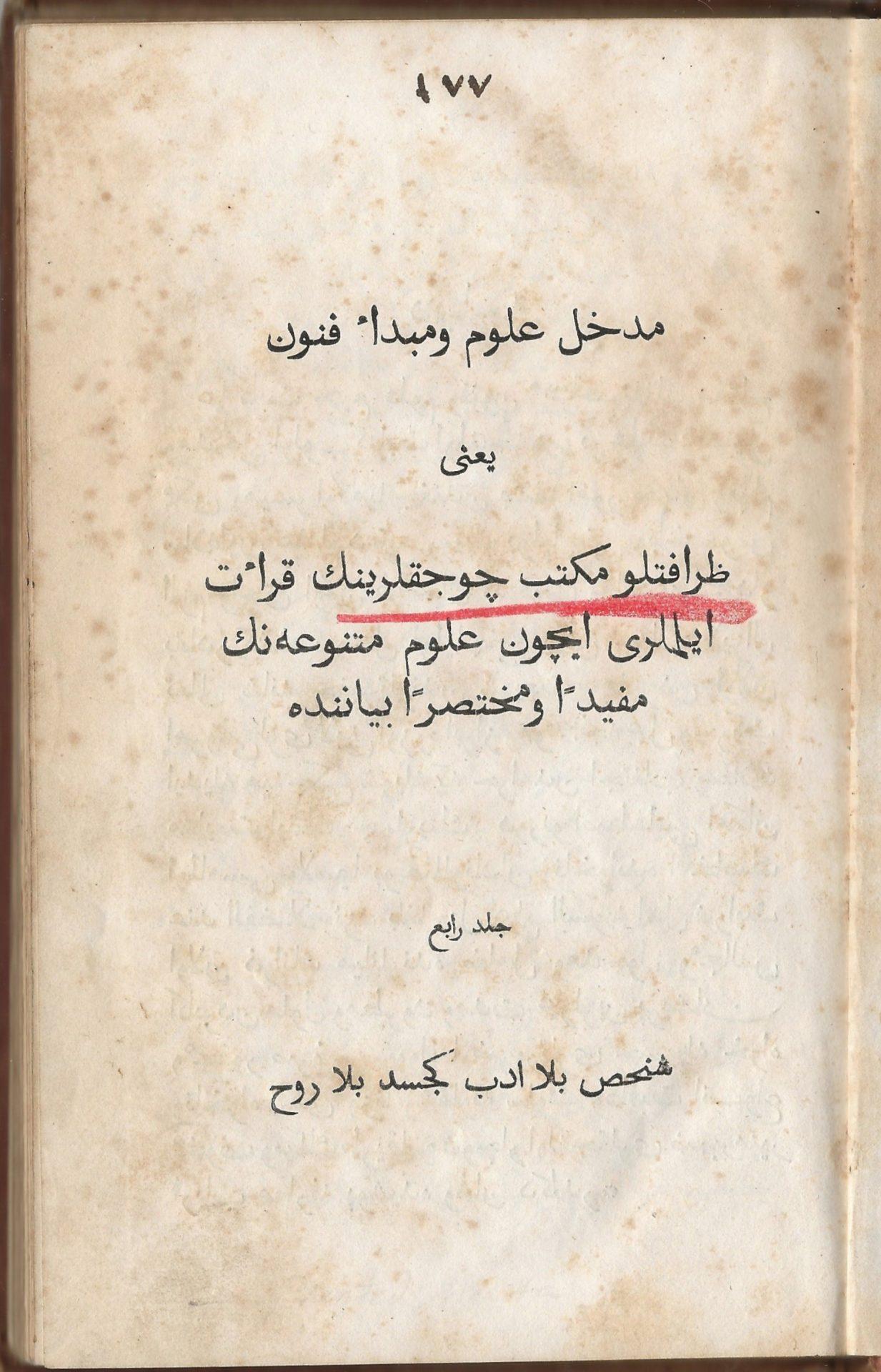
This very rare and attractive work is the first children’s textbook on geography, astronomy and physics to have been published in the Ottoman Turkish language. It was issued by the press that the Protestant organization, the Church Missionary Society (CMS), operated in Malta between 1825 and 1842. While the printshop specialized in publishing Arabic books, the present work is one of only eight Ottoman books issued by the press, from 1834 to 1839, as part of a design to reach out to Turkish Muslims in the Ottoman Empire, a potentially dangerous endeavour, as such activities were strictly forbidden by the Sublime Porte.
The book was compiled by the Swedish missionary Peter Fjellstedt, who was based at the CMS mission in Buca, near Izmir, and with the assistance of a local scholar Yusuf Efendi, he translated and amalgamated portions of various issues of William Pinnocks’s Catechisms (summaries of topics) on science, a series of extremely popular English children’s books. Fjellstedt’s manuscript was then edited in Malta by Ahmad Faris Al-Shidyaq, a Lebanese Christian, who is today renown as one of the fathers of modern Arabic journalism and literature, as well as great master of Ottoman Turkish.
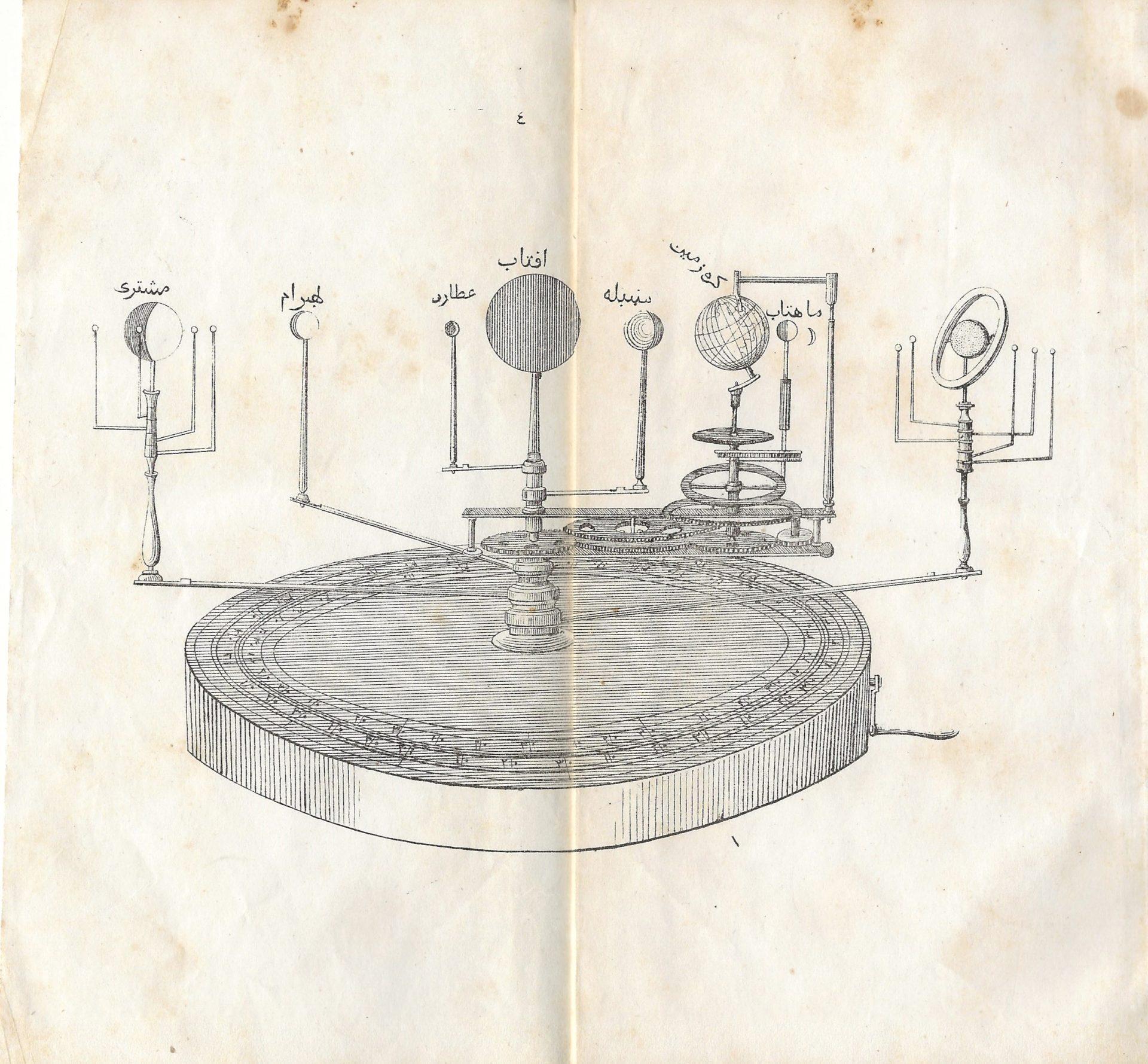
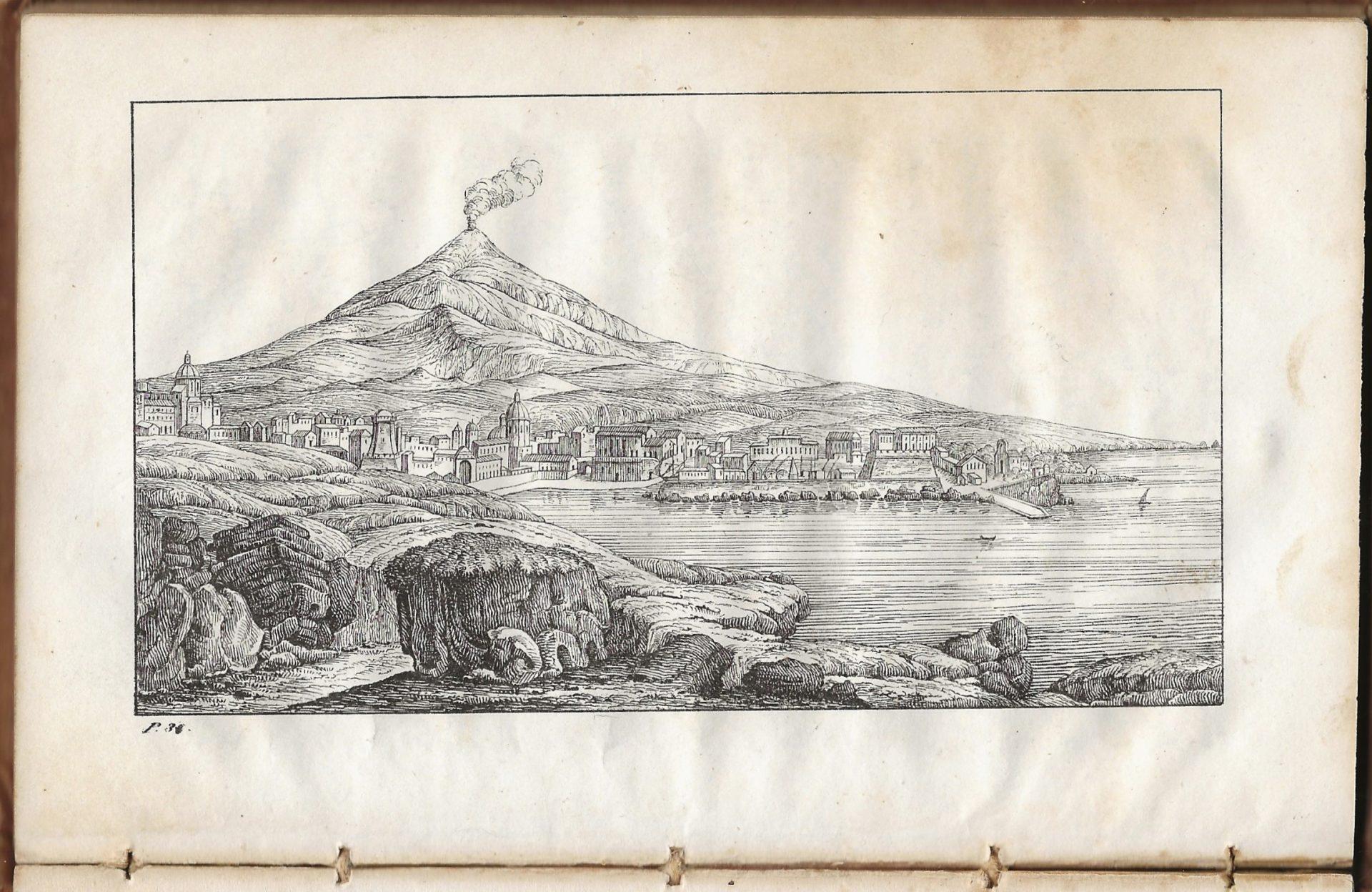
The work is illustrated with nine attractive plates (including 2 views and 7 of scientific diagrams), clearly derived from European sources. Most libraries and some bibliographies erroneously cite the work as having been issued in 1836, although the scholar Geoffrey Roper has conclusively proven that it was published in 1839.
The present work was part of an envisaged, but never completed, series of four volumes of scientific children’s books, of which only volumes 2 and 4 (being the present work) were ever completed. Importantly, the volumes were separately issued as stand alone, self-contained works.
The 9 Plates within the book include: 1. View of a Man Flying a Kite that is Struck by Lightning, so illustrating Electricity (between pp. 28 and 29); 2. View of Vesuvius and Naples (between pp. 36 and 37); while the following scientific plates are located following the final text page, and include: 3. Instruments including a Balance, Thermometer and Weights; 4. Instruments including Wheeled Devices; 5. Instruments including Devices with Screws; 6. The Earth’s Orbit around the Sun; 7. The Relationship between the Sun, Earth and the Moon; 8. An Orrery (Folding, double page size); and 9. The Solar System (Folding, double page size).
That the present work is the first children’s textbook on geography, astronomy and physics to have been published in the Ottoman Turkish language is due the fact that up to that point, the Sublime Porte maintained a very high degree of state censorship and control over publishing in that language within its domains (although publishing in other languages within the empire was quite freely practiced). While educational works for adults existed, children’s literature was as yet an undeveloped field, creating a vacuum that could be filled by Christian missionaries hoping to forge connections with Turkish Muslims.
A Note on Rarity
The present work is very rare, as a fragile children’s book, it would have had a very low survival rate. We can trace only 3 institutional examples, held by the Library of Congress, the Österreichischen Nationalbibliothek (Vienna); and the Bodleian Library (Oxford University).
Early Ottoman Printing in Malta
The Christian Missionary Society Press in Malta was established within a very complex and turbulent socio-political environment. The Ottoman Empire, which sprawled across large parts of three continents, was one of the world’s most religiously and ethnically diverse nations. While the state religion was Sunni Islam, the empire’s large Jewish and Christian (Eastern Orthodox, Armenian, Maronite and Assyrian, etc.) minorities were permitted an extremely high degree of autonomy and, in many areas, these communities enjoyed great economic and even political power. Yet, in the wake of the Napoleonic Wars, the empire was beset by internal dissent, pressure from foreign powers and economic instability, which sometimes caused the Sublime Porte to follow a reactionary course.
During the same period, European and American Christian missionaries were keen to operate within the Ottoman Empire, and various international treaties that the Sublime Porte signed allowed them to work there under certain conditions. The missionaries were permitted to administer to and educate only Ottoman subjects who were already Christians, while the promotion of Christianity to Muslims was strictly forbidden. Many Protestant missionaries were eager to, rather arrogantly, ‘correct’ the practices of Orthodox, Maronite and Assyrian Christians whom they considered to be “nominal Christians”.
However, some of the most zealous missionaries were determined to pursue an intellectual ‘dialogue’ with Muslims, in the hope of opening the door to proselytization. Such was a very dangerous game, as the Ottoman government, not to mention local imams, would be inclined to vehemently oppose such activities. In truth, the Sublime Porte was not thrilled by the presence of any foreign Christian missionaries on their soil, and often sought to frustrate their plans.
The main vehicle for promoting Christianity in the Ottoman Empire was the printed word. For generations, Christian organizations, notably the Roman Catholic Church’s Propaganda fide office, had religious works printed in Europe in various Asian languages (including Ottoman Turkish) for distribution overseas, but these tomes tended to have a very limited readership.
In the first half of the 19th century, Protestant missionaries issued cheap, mass produced religious texts, as one had to be able to read the Bible in their one’s own language in order to know the faith. Thus, missionary organizations printed books in America and Western Europe for overseas distribution, while setting up presses in the field all around the world, creating an amazing variety of educational and religious works. In particular, providing educational literature to children, even on secular topics, provided a good conduit to religious indoctrination.
In the early 19th century, printing was a politically charged topic in the Ottoman Empire. While the Sublime Porte had long allowed its minority communities to print pretty much whatever they wanted (so long as the works did offend Islam or question the Ottomans’ authority), publishing that employed Arabic script and works geared towards Muslims, were highly controversial. There was resistance to printing works in Arabic and Ottoman Turkish of any kind from conservative theologians, who wished to preserve the sacred nature of the Islamic scriptorial tradition; printed works were seen as a ‘cheap imitations’ of works painstakingly made by hand. Moreover, the Sublime Porte, seeing what had transpired in Europe since the Reformation, was weary of the press, less it lose control over what its Muslim subjects thought and expressed. For centuries, while printing in Arabic was permitted in some places (notably Lebanon) for exclusive dissemination to Christians, all printing in Ottoman Turkish was banned throughout the empire until the imperial courtier İbrahim Müteferrika was permitted to operate a press issuing works in that language between 1729 and 1743, although the ban was subsequently reimposed.
In 1797, during the enlightened reign of Sultan Selim III (r. 1789 – 1807), a state sponsored press was established in Istanbul that published religious, literary and scientific works. However, during the bloody revolution of 1807, led by the Janissary corps, that overthrew Selim III, the matter of the press was one of the lightning rods of conservative discontent.
While state-sponsored printing in Ottoman Turkish was revived during the reign of Sultan Mahmud II (r. 1808-39), output was heavily censured, with production confined to traditional works of religion and literature, some technical tomes, as well as government tracts.
Meanwhile, in Egypt (which while was a de jure part of the Ottoman Empire was in reality an independent state), in 1822, its ruler Muhammad Ali established the Bulaq Press, which published a wide variety of titles in both Arabic and Ottoman Turkish, although the output was likewise censored by the authorities.
Importantly, children’s literature was not a priority for the early Ottoman and Arabic presses, and the field remained undeveloped until quite a late stage.
Enter the Church Missionary Society (CMS), which survives to the present day as the Church Mission Society. It was founded in 1799 in England as a vehicle to spread the Anglican Protestant faith around the world. Well-funded and backed by politically influential figures, the CMS rapidly established missions all over the world. The Middle East, called the ‘Mediterranean Sector’, was of great interest to the CMS, and in 1815 their operations there were inaugurated by Reverend William Jowett. From 1819-21 Jowett attempted to establish missions in Anatolia, but this was frustrated by the Ottoman authorities.
The CMS then decided to focus upon deploying transient missionaries to spread the ‘proper’ practice of the faith amongst the empire’s large Christian communities. Naturally, the missionaries required books written in Arabic. While Christian printing in Arabic and Syriac had long thrived in Lebanon, the Ottoman authorities had made it plain (at least for the time being) that foreign Christian missionaries would not be permitted to publish books in Turkish on Ottoman soil. Indeed, it seems that the Sublime Porte was sceptical of the CMS, perhaps (with good reason) suspecting that they intended to open a ‘dialogue’ with Muslim communities.
The CMS turned to Malta as a base for their operations in the Ottoman Empire. Malta was in many ways ideal, as it was British colony with an ardently Christian population, while it had close geographic proximity and strong cultural and economic ties to the Ottoman lands.
In 1825, the Reverend Jowett set up of a printing press in Malta to publish books in Arabic, its operations benefitting greatly from the involvement of Ahmad Faris Al-Shidyaq (1804 – 1887), a Lebanese Christian who was a pioneer of modern Arabic literature and journalism. The CMS press produced approximately 100 Arabic titles over the 17 years of its operation, until it closed shop in 1842. These works consisted of Christian religious texts and educational works, including the first world atlas printed in Arabic.
Importantly, the CMS printing operation should not be confused with the press that the American Board of Commissioners for Foreign Missions (ABCFM) ran in Malta from 1822 to 1834, which specialized in printing books in Greek and Italian; it did not issue any works employing Arabic script.
Meanwhile, in the early 1830s, the missionary John Andrew Jetter was able to establish a CMS mission in Anatolia, at Buca, near Izmir. Jetter decided that his mission should distribute texts written in Ottoman Turkish. This was a risky move, as such books were inherently geared towards a largely Muslim audience (Turcophile Christians usually read in other languages / scripts), and while it was perfectly legal for missionaries to distribute secular books to Muslims in the Ottoman Empire, such actions could easily be interpreted as a prelude to proselytization. Certainly, distributing any religious material would see the missionaries cross a legal red line.
Jetter worked in Izmir with Yusuf Efendi, a local scholar and translator, to write the first Ottoman books for the CMS press in Malta, adapting the press’s existing Arabic type. In 1834, the press issued its first two books, a simple beginners’ reading and spelling book and illustrated schoolbook on natural history. This was followed, in 1836, by an alphabet primer. These books were later proven to be full of errors, as Jetter and Yusuf’s work had not been well coordinated with the technical side in Malta.
In 1836, Jetter was joined in Buca by a Swedish colleague, Peter Fjellstedt (1802 – 1881), a man of great intellect and energy. After graduating from Lund University, Fjellstedt joined the CMS in 1829, and procced to study Arabic, Ethiopic, Coptic and Persian in London and then Greek in Basle. From 1831 to 1835, he served in the field in India.
Fjellstedt was highly critical of the quality of the three Ottoman books that the CMS had published to date, lamenting “the typographical errors are very numerous, because there was no corrector [in Malta] there who understands the Turkish”. He was a strong believer in the need for Ottoman books for distribution in Anatolia and the southern Balkans and seems to have been committed to ‘pushing the limits’ of what the Ottoman authorities would tolerate with respect to entering a ‘dialogue’ with Turkish Muslims.
Early on, Fjellsedt noted that “our chief immediate object must naturally be… preparing school books on the elements of the various branches of education, & this is what we at present [September 1836] endeavour to do”.
Fjellstedt envisaged creating a four-volume series, totalling around 300 pages, that would introduce young readers to the elements of science, illustrated with plates. He translated selections from William Pinnock’s popular Catechisms on science, which were published in London in various editions from 1817. In Izmir, Fjellstedt translated the works from English into Ottoman with the assistance of Yusuf Efendi, while the proofs were sent to Malta be edited by Faris Al-Shidyaq, before being brought to press. However, only two of the four parts, volumes 2 (the animal world) and 4 (geography, astronomy and physics, being the present work) were ever completed, with both being issued in 1839.
Later the same year, Fjellstedt entered dangerous territory, when he had the Malta press publish two works on Christian theology in Ottoman Turkish, ‘On Manners & Morals’ and ‘On the Attributes of God’. These books could easily land any missionary in hot water, and surely had to be distributed with caution, often via Christian booksellers in Ottoman cities.
The final Ottoman title issued by the CMS press was an Ottoman spelling book, likewise printed in 1839.
The CMS press at Malta issued a total of only eight titles in Ottoman Turkish, as it seems that the programme ceased when Fjellstedt left Turkey for Central Europe, in 1840. While the output of the books was brief, it seems that the CMS was quite successful in ensuring that the works were distributed all across Anatolia and the Southern Balkans. In 1841, the CMS Committee remarked that the titles “have already awakened much wonder and inquiry among the Turks”, while many Christian booksellers in various cities are recorded as handling them. However, it was also observed that by 1847, very few of the books remained in circulation.
Regardless of their brief appearance on the scene, the Ottoman Turkish books from the CMS press in Malta occupy an important place in the history printing in that they are generally the first educational works for children published in Turkish.
During the Tanzimat Era (1839-75), which commenced the very year that the present work was published, the Ottoman Empire radically liberalized its laws with regard to the rights of ethnic and religious minorities. While official censorship remained strong and prevalent, the Sublime Porte also relaxed is regulations on printing in Ottoman Turkish, fostering a dramatic proliferation of publishing in a wide variety of subjects, including the development of sophisticated, modern children’s literature.
References: ÖZEGE, no. 12677; Library of Congress: Q183.4.T9 M43 1836; Österreichischen Nationalbibliothek (Vienna): 30406-B.4 ALT MAG; Geoffrey ROPER, ‘Arabic printing in Malta 1825-1845: Its history and its place in the development of print culture in the Arab Middle East’, Ph.D. Dissertation, University of Durham (1988), List, no. 84 (p. 343); Geoffrey ROPER, ‘Turkish Printing and Publishing in Malta in the 1830s’, Turcica, 29, 1997, pp. 413-421 (citing present work on p. 420 as ‘Turkish Books Printed in Malta 1834-1839’, no. 5); J.T. ZENKER, Bibliotheca Orientalis, vol. I, no. 1273.
![OTTOMAN WORLD ALMANAC: سال هديه [Hediye-i Sal / New Year]](https://pahor.at/wp-content/uploads/2020/06/2019-05-27_214251-265x331.jpg)


Reviews
There are no reviews yet.