
Description
Founded in 1567, Caracas was located at an elevation of around 900 metres at the western end of the 25 km-long Valley of Caracas. It historically followed an orthodox Latin American urban plan predicated upon an even grid of streets, focussed upon a central plaza. For generations, Caracas remained a relatively small, slow-growing city, as Venezuela was primarily a rural, agrarian economy.
The fate of Caracas, and indeed all Venezuela, was radically transformed upon the advent of the country’s oil boom, which commenced in the 1920s and lasted until the 1950s (by 1940 Venezuela was the third largest producer of crude oil, annually producing more than 27 million tonnes!). This spurred rapid economic growth and industrialization, leading to the mass migration of Venezuelans into urban areas, especially Caracas. The population of the city increased from 92,212 in 1922, to 269,030 in 1941 (with 380,099 in the Federal District) and then to 495,064 (with 693,896 in the Federal District) in 1950. By 1960, Caracas would have 786,710 residents (with 1,362,189 in the Federal District), which included not only Venezuelans, but also 350,000 foreigners who had recently immigrated, following opportunities created by the oil boom.
As was the case with other major Latin American metropolises, Caracas’s hyper-growth caused the city to expand chaotically beyond its neat traditional plan. Shabbily built and poorly designed suburbs and slums developed overnight, leading to low living standards and severe traffic problems in many places.
In 1939, the authorities engaged the esteemed French urban planner Maurice Rotival (1892 – 1980), who was responsible for his redesigning Algiers, to create a new masterplan for the Venezuelan capital. The resulting Modernist “Plan Rotival” envisaged a city of new, orderly neighbourhoods along a thoroughfare (highway), La Avenida Bolívar. While Rotival’s vision would never be fully realized, the 2 km-long La Avenida Bolívar was constructed between 1945 and 1949, and grand monuments like a new Capitol Building and a mausoleum for Simón Bolívar were also built.
In response to Caracas’s continued hyper-growth, the Ministerio de Obras Públicas created the Comisión Nacional de Urbanismo, led by world famous urban planners and architects, including an encore by Maurice Rotival, plus, Francis Violich (American, 1911-2005), Jacques Lambert (French, 1884 -1960) and Josep Lluís Sert (Catalan, 1902 – 1983), to create a new far more ambitious masterplan for Caracas, a bold Modernist vision for extending urban growth eastward across the entire Valley of Caracas.
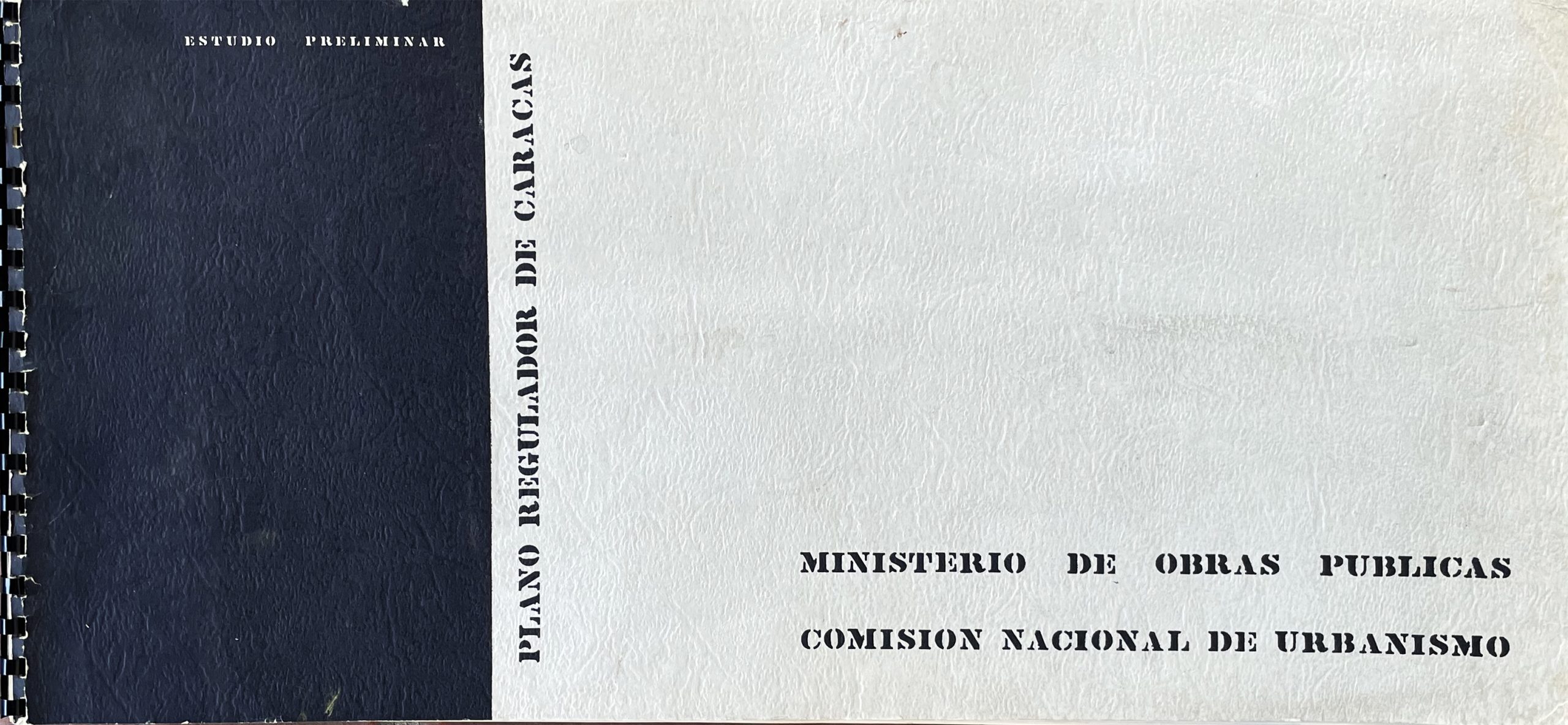
The Comisión duly completed the present Estudio preliminar (Preliminary Study) of the Plano regulador de Caracas (Regulatory Plan of Caracas), which was published locally in 1951 by the press of the Miangolarra Hermanos. Employing advanced techniques of thematic cartography and statistical analysis, the committee presented an exhaustive study of Caracas’s historical growth, land use, real estate values, population density, and transportation flows, as they changed between 1936 and 1951, so as to develop a masterplan fit for the capital of one if the world’s fastest growing economies. The Modernist vision included orderly zoning, ample parkland, with urban spaces centred on large scale (often high-rise) developments, connected by grand avenues and highways. The highlight was to be the Avenida Libertador, the 24 km long ultramodern expressway that was to run from the city centre eastwards all the way across the Valley of Caracas, so connecting the new suburban zones.
After a brief ‘Introducción’, the Estudio preliminar features 12 maps (11 full page, 1 in colour), accompanied by explanatory text, as well as multiple statistical tables, plus 1 large colour lithographed folding map which acts a master overview of the Plano regulador de Caracas.
The maps are as follows:
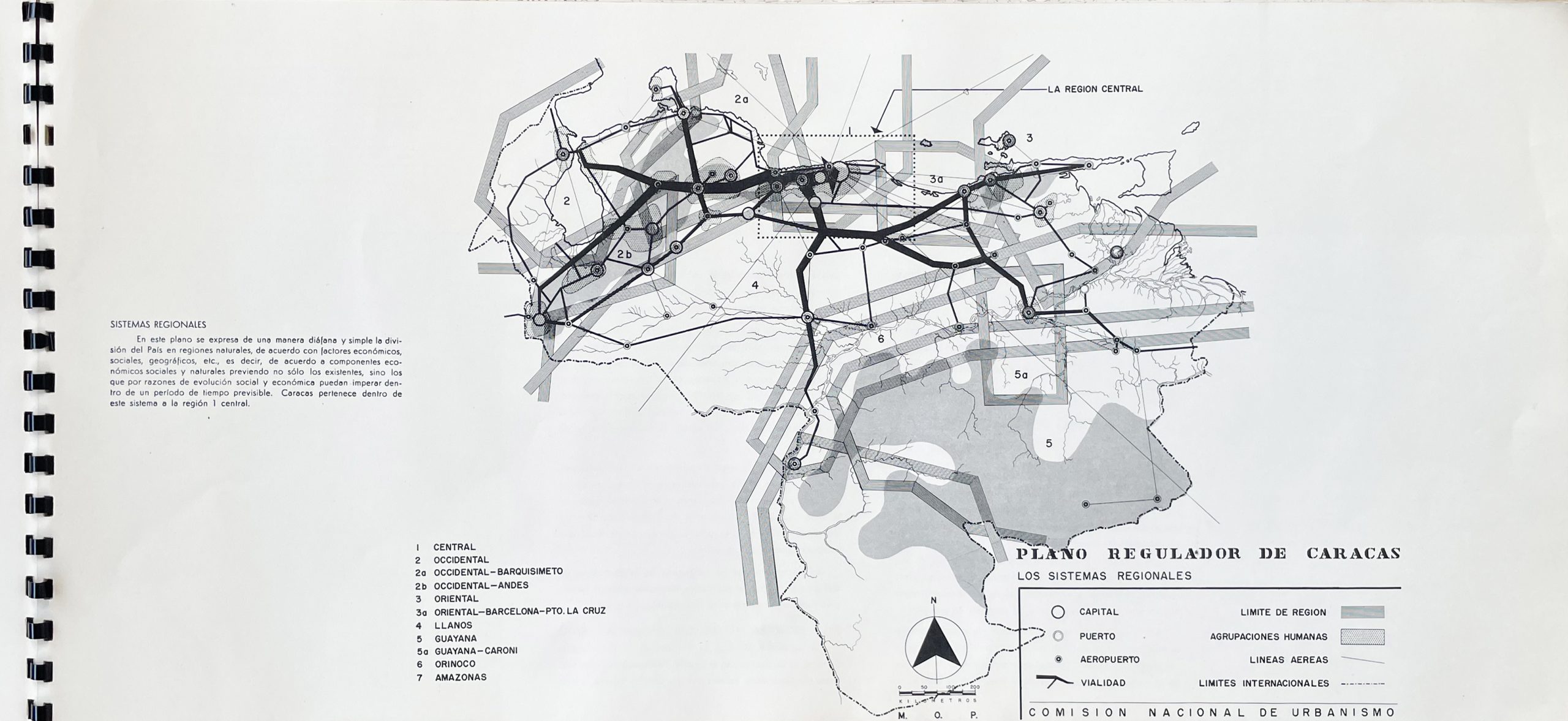
1. [on p. 1:] Los Sistemas Regionales. [Regional Systems].
This full-page work is a sophisticated ‘flow map’ of all Venezuela that emphasizes the importance of Caracas within the national transportation system. It employs lines of varying thickness to show the relative traffic along the country’s main transportation corridors.
2. [on p. 3:] La Región. [The Region].
This half-page map (which relates to its partner map on the same leaf) is a transportation flow map of northcentral Venezuela which shows the relative traffic levels along the major transportation corridors, noting the connections between the populated areas, agrarian zones and cattle ranching areas.
3. [on p. 3:] El Sector. [The Sector].
This second map on the leaf focus upon the transportation and utilities corridors in the greater Caracas region, noting expressways, other major roads, water lines, as well as the light and gas lines heading into the city.
4. [on p. 5:] Crecimiento Histórico de la Ciudad. [Historical Growth of the City].
This fascinating map shows the phased historical growth of greater Caracas, from the modest bounds of its old colonial city to the urbanised areas founded in 1830, 1900, 1930 and 1950. Indicative of Caracas’s recent growth, it shows that the great majority of the city’s metropolitan expanse appeared in the generation before the Estudio preliminar was made.
5. [on p. 5:] Uso Actual de la Tierra 1936. [Current Land Use 1936].
This map depicts land use patterns throughout the Caracas Valley as of 1936, including zones of detached houses, high-density residential (i.e., apartment buildings), industry, commerce (white collar), administration, education/cultural, parks & recreation, and agriculture.
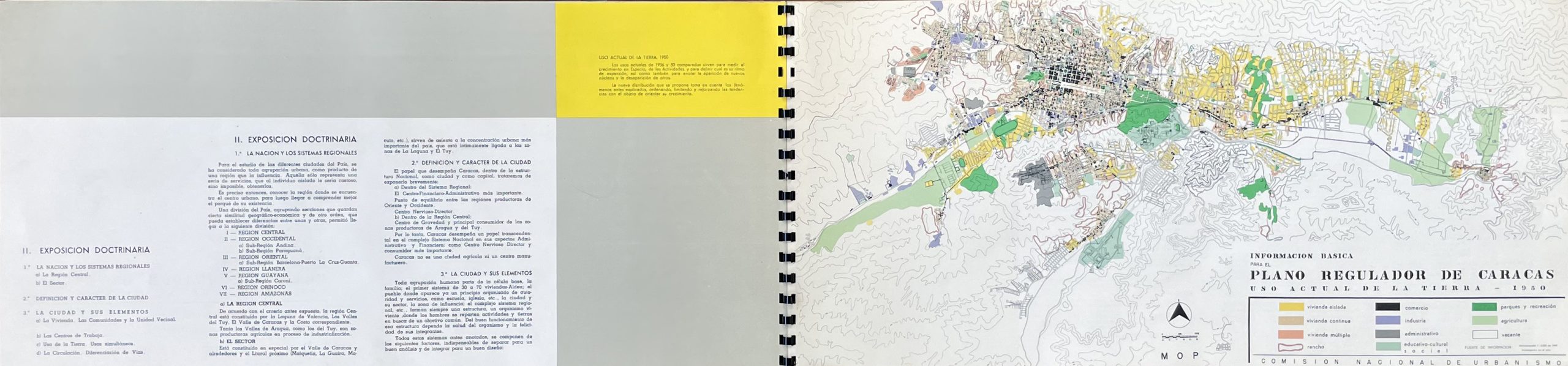
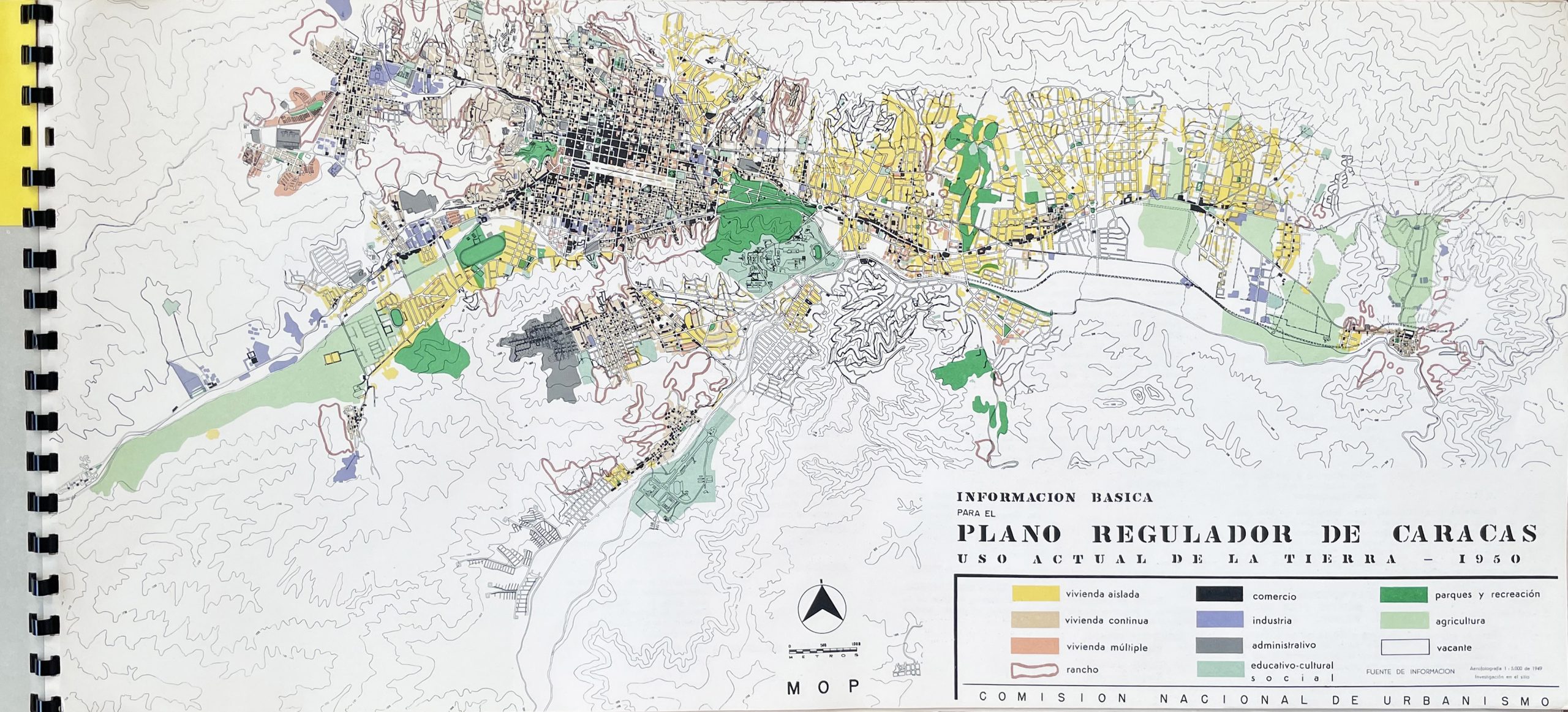
6. [on p. 7:] Uso Actual de la Tierra – 1950. [Current Land Use – 1950].
This coloured map depicts land use in metro Caracas as of 1950, in the wake of the partial implementation of the original ‘Plan Rotival’. It employs colour-coding to show the land use categories as featured on the previous map, plus, extra entries for zones of multiple use dwellings, ranch land, and vacant areas.
7. [on p. 9:] Distribución de los valores inmuebles en la Ciudad – 1938. [Distribution of Real Estate Values in the City – 1938].
Here various types of shading show the property values (in Bolívars per sq. metre) across the Valley of Caracas as of 1938. This indicates that the only real estate of any real value was then located in and around the old city, in the west of the valley.
8. [on p. 11:] Distribución de los valores inmuebles en la Ciudad – 1951. [Distribution of Real Estate Values in the City – 1951].
This map, which updates the former to 1951, depicts revolutionary changes. While the most valuable real estate was still located in and around the old city core, in the west of the valley, some of the land along the new transportation corridors down towards the east of the valley was now of significant value (and indeed rising). Generally, the further from the main arteries, the less valuable was the land.
9. [on p. 13:] Distribución de la población – 1936. [Population Distribution – 1936].
Here the population distribution of greater Caracas is shown as of 1936, with one dot representing 25 persons. The great majority of the dots in the Valley of Caracas were concentrated near the old city centre, with only small towns located in the east of the valley.
10. [on p. 15] Distribución de la población – 1950. [Population Distribution – 1950].
This map updates the former to 1950 and shows the innumerable new points representing 25 persons that have proliferated throughout the Valley of Caracas, indicative of the metro area’s explosive growth over the previous 14 years.
11. [on p. 17] Limites de municipios parroquias y urbanizaciones – 1951. [Boundaries of Municipalities, Parishes, and Urban Areas – 1951].
This map defines and names all the parishes and municipalities in greater Caracas as of 1951, many of which had sprung up in the previous decade or so. Many places that were only very recently totally rural and agrarian were now built-up urban areas.
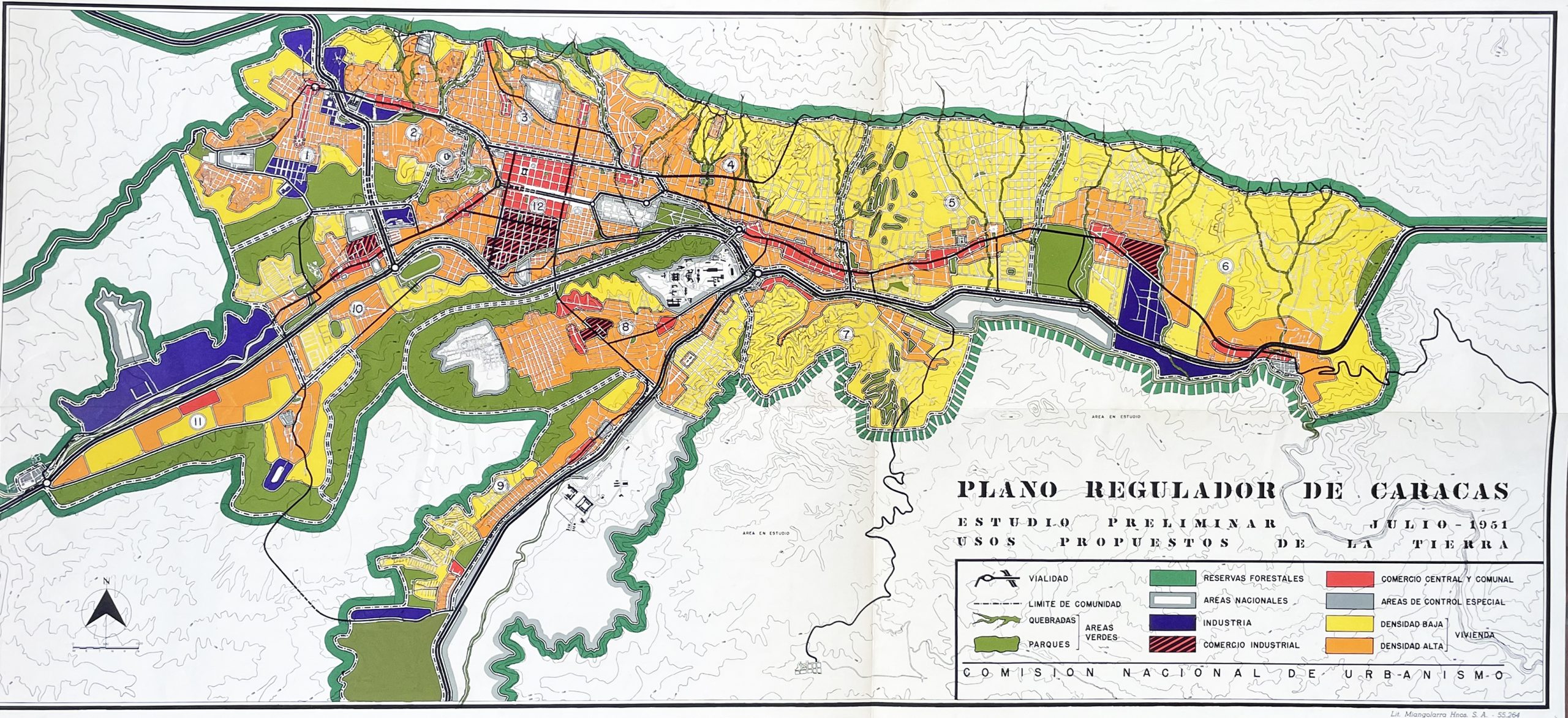
12. [on p. 19] Estudio preliminar / Usos propuestos de la tierra / Julio – 1951. [Preliminary Study / Proposed Land Uses / July – 1951].
Please see the description for Map 13 below, which is an enlarged and coloured version of the same.
[13., or the grand folding map:] Estudio preliminar / Usos propuestos de la tierra / Julio – 1951. [Preliminary Study / Proposed Land Uses / July – 1951].
This grand folding coloured map (measuring 44.5 x 94.5 cm) is the master map of greater Caracas as envisaged by the Plano regulador de Caracas, showing the ‘Modernist’ city as the Comisión Nacional de Urbanismo envisaged, with careful zoning, new orderly neighbourhoods and ample parkland, all connected by rapid transportation arteries. The legend in lower right explains the symbols employed to identify roads, community boundaries, ravines and parks, forestry reserves, government lands, industrial zones, commercial zones, the central business district, special control zones, as well as high- and low-density residential areas. It shows how high-density development generally followed the new major arteries, with traffic carefully regulated, so allowing workers to travel to and from work without undue congestion.
Additionally, a 2-page section, ‘Apendice: Quadros Estadisticos’, features line, bar and statistical charts quantifying many of the variables covered by the work’s maps.
A Note on Rarity
The work is rare. We can trace examples in 9 institutions, including MIT Libraries, Yale University, Cornell University, University of Pennsylvania, University of Pittsburgh, University of Oregon, University of Texas–Austin, Biblioteca AECID (Barcelona) and the University of Liverpool. Moreover, we cannot locate any sales records for any other examples.
Epilogue
In the wake of the present work, the Comisión Nacional de Urbanismo submitted their final report in July 1952. While the national and Caracas governments embraced its vision, the subsequent collapse of oil prices and the extreme political instability of Venezuela made progress difficult. While the Avenida Libertador was built between 1957 and 1965, largely as planned, many of the new neighbourhoods were constructed in a haphazard manner, or then not at all. Moreover, the population of Caracas grew at such a rapid pace (it surged above 2 million in 1970!) that it became difficult to main orderly urban planning. Yet, the Plano regulador de Caracas did have a legacy in that the city became one of high-rise neighbourhoods along major arteries, even if it was not the one Rotival & Co. dreamed of.
References: MIT Libraries: FOLIO HT169.V4.P53 1952; Yale University: JJax34 S78 951V; Cornell University: Library Annex NAC6882.C18 V5; University of Pennsylvania: LIBRA Folio NA9182.C3 V4 1951; University of Pittsburgh: HT169.V4 P53 1952; University of Oregon Libraries: NA9182.C3 A35; University of Texas Libraries – Austin: -F- HT 169 V42 C385 1951; Biblioteca AECID (Barcelona): 6B-21112; University of Liverpool, Sydney Jones Library: HT169.V4.C .V45; OCLC: 21993392. Cf. Arturo Almandoz Marte, Urbanismo europeo en Caracas (1870-1940) (2006), p. 323; Arturo Almandoz Marte, ‘The Masa’s Odysseys through Bourgeois Caracas: The Testimony of Novels, 1920s–1970s’, in Wladimir Fischer-Nebmaier, Matthew P. Berg and Anastasia Christou (eds.) Narrating the City: Histories, Space and the Everyday (New York, 2015), pp. 75-96; Douglas Miguel Llanos and Rafael E. Martínez Bellorín, ‘La Planificación Urbana en la Ciudad de Caracas, Venezuela (1936-2013): En Busqueda de la Modernidad Perdida, in Roberto Goycoolea Prado (ed.), Modernidades Ignoradas. Nuevas Indagaciones sobre arquitectos y obras (casi) desconocidas de la arquitectura moderna (Puebla, Mexico: Red de Investigación Urbana México, 2014), pp.41-55; Juan José Martín Frechilla, Diálogos reconstruidos para una historia de la Caracas, 2004), p. 226.


