
Description
This is a fascinating and historically significant archive from the papers of Brigadier General Frederick Walshe (1872 – 1931) from his time as an intelligence officer in British India during the charged era leading up to World War I. Walshe later became the commander of an ANZAC Mounted Brigade during the war (serving in Egypt, Gallipoli and France) and then a senior intelligence officer in Russia, before capping his career as Aide-de-Camp to King George V.
The archive focusses on military intelligence training in British India and includes dozens of classified manuscript and typescript documents, and three especially interesting maps. Taken in sum, the archive is an extremely valuable, unvarnished insight into the nature of spycraft and information gathering by one of the great powers in a critical geopolitical theatre at a key historical juncture. It must be said that any collections of original documents concerning intelligence operations only very rarely appear on the market, owing in good part to their clandestine nature.
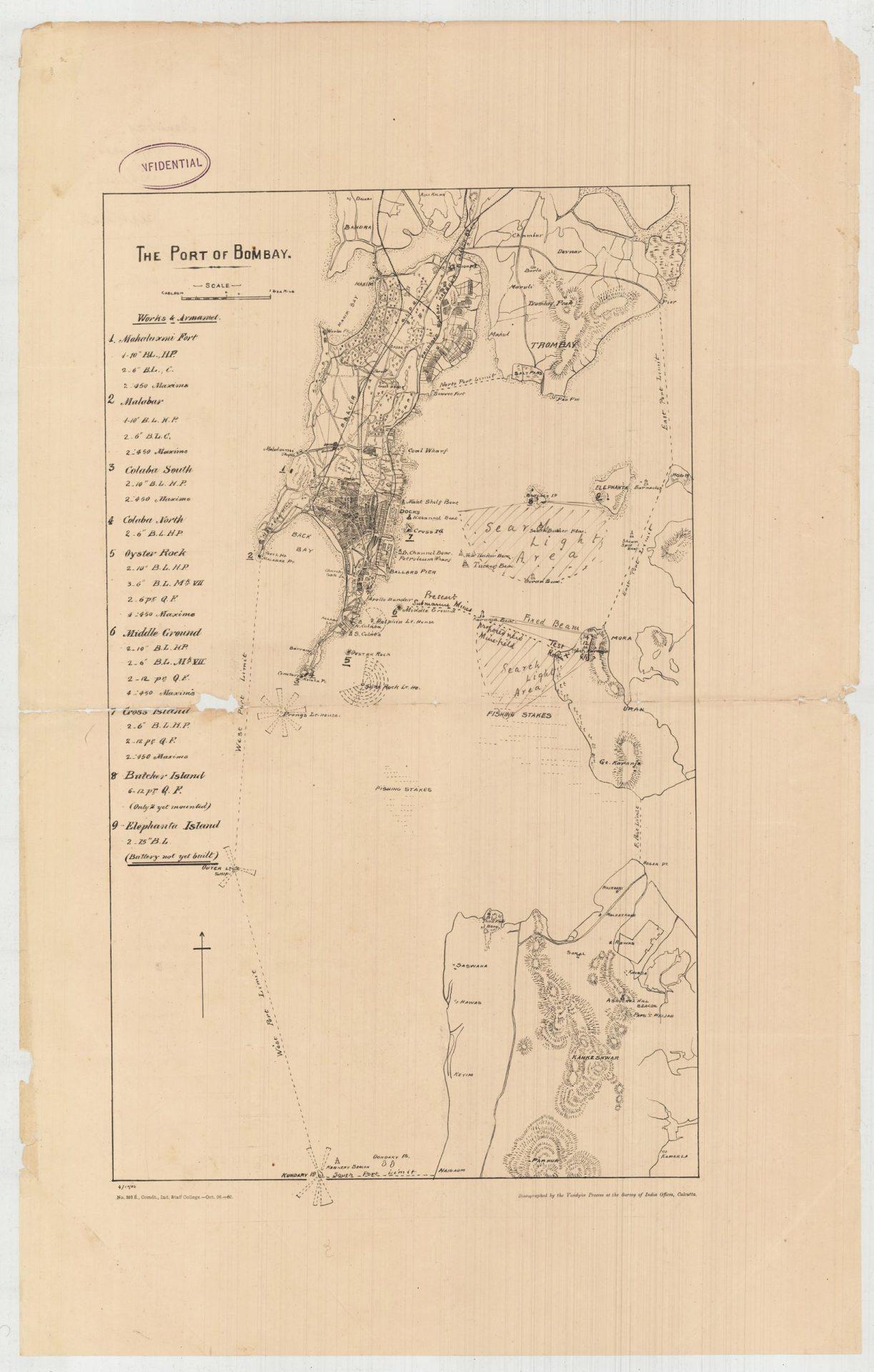
The archive consists of four parts. Part I concerns Walshe’s own advanced intelligence training, including his proposal a new defensive plan for Bombay, illustrated by a seemingly unrecorded, large format “classified” map of Bombay Harbour, printed in 1906 by the Survey of India.
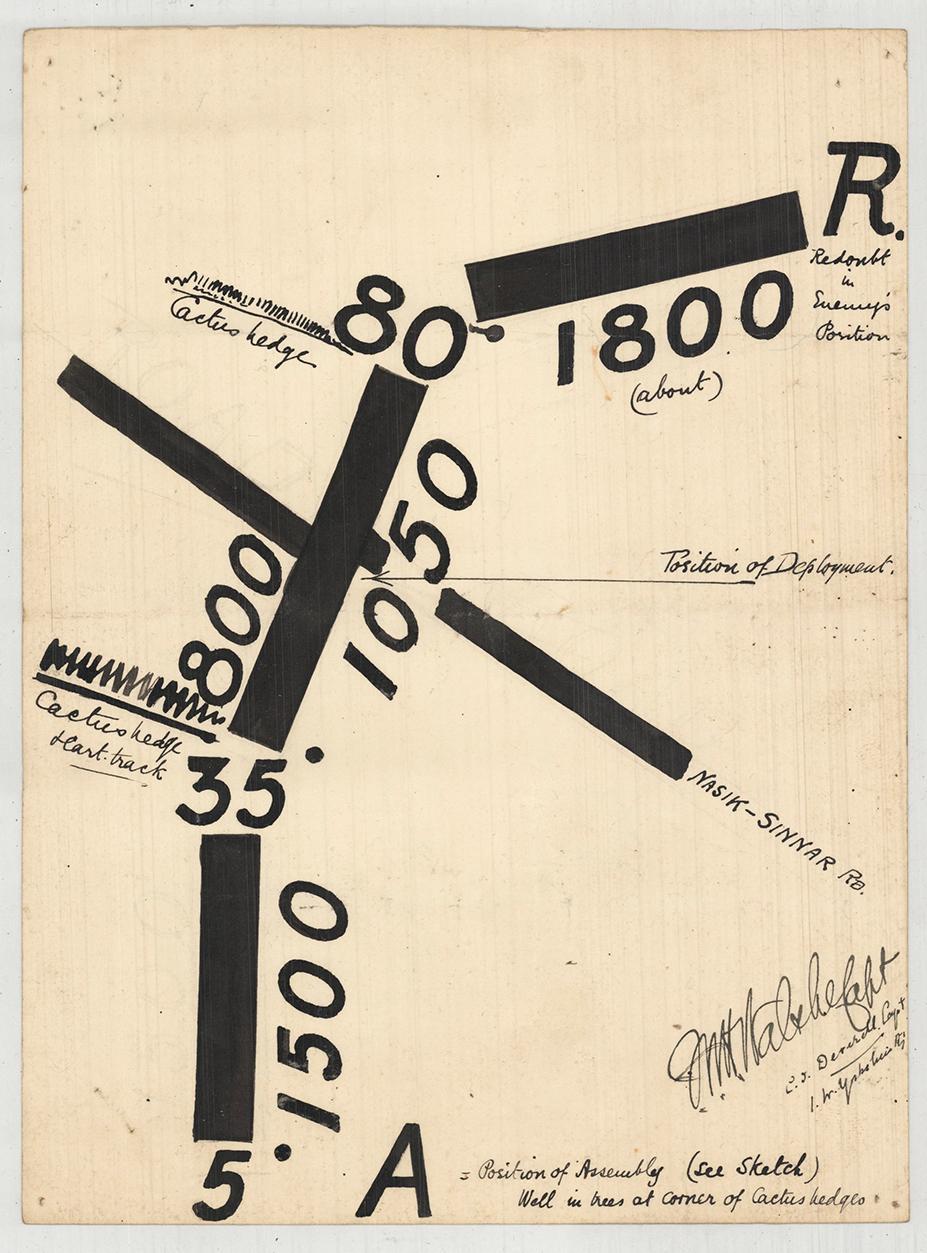
Part II continues with Walshe participating in a plan for night-time War Games to be staged outside of Nashik (Maharashtra), India, illustrated by an amazingly innovative manuscript plan, specifically designed to be readable at night.
Part III concerns the period, from 1908 to 1911, when Walshe was himself an instructor, educating military officers on intelligence in Peshawar, in the North-West Frontier Province (today Pakistan). Featuring numerous manuscript and typescript papers, including Walshe’s original lesson plans, lecture notes and academic reports on such issues as intelligence gathering protocols (in both war and peace), guiding troops, astronomy, codes and ciphers, opposition research, how to share and protect secrets, amongst other intriguing topics. Also, present, and of great value, are series of Walshe’s research papers on India’s disputed boundaries with China, providing a privileged account of one of the great geopolitical matters of the time; this section features Walshe’s own large format manuscript map of the boundaries of British India.
Historical Context: Tensions Rise along the Himalayas
The present archive, the contents of which generally date between 1906 and 1911, were made in British India during an especially tense period in geopolitical history. Great Britain was winding down The Great Game, its almost nine-decade long Cold War with Russia over control of the heart of Asia, which formally ended upon the signing of the Anglo-Russian Convention of 1907. However, in Russia’s place, Germany was coming on fast and furious, building a massive navy to rival that of Britain. It was also forging an alliance with the Ottoman Empire, building the Baghdad Railway, which would, if completed, allow Germany to strike at the core of British interests in the Persian Gulf and the Indian Ocean. Germany was coming on fast and furious, building a massive navy to rival that of Britain.
At the same time, Britain was concerned with ensuring that India’s northern frontiers ran up well into the Himalayas, not just to create a better defensive perimeter for the Raj, but to gain control of a good portion of the headwaters of the Subcontinent’s main rivers; possession of the water supply could mean the difference between prosperity and famine. At the Simla Convention (1913-4), Britain pressured China and Tibet to agree to a boundary, the McMahon Line, which largely favoured India, granting it title to such regions as modern Arunachal Pradesh. While China would later dispute the line, the Simla Convention set a precedent which would prove hard to overturn.
As the Great War drew closer, Britain urgently needed to expand its intelligence capacities, especially in India, where German spies were stirring up trouble amongst the Subcontinent’s politically restless communities, and while its coasts and frontiers remained vulnerable to enemy attack. Walshe’s work to educate a new generation of military intelligence operatives would have been of immense benefit to the British Empire.
Frederick Walshe: A Man at the Centre of Key Events on Three Continents
Brigadier General Frederick William Henry Walshe (1872 – 1931) was an Anglo-Irish soldier, a senior field commander during World War I and the Aide-de-Camp to King George V. During his 36 year-long military career he served in Britain, India, Egypt, Gallipoli (Turkey), France, Belgium and Russia.
Born to a landed family from County Kilkenny, Ireland, Walshe was educated at Bedford School and at the Royal Military Academy at Woolwich. It is likely at Woolwich that he was trained in draughtsmanship, and combined with is great natural artistic virtuosity, he became an unusually skilled artist; he sketched what he witnessed constantly throughout his life (as evidenced by many works within the present archive).
In 1892, Walshe was commissioned a 2nd Lieutenant in the Royal Artillery and served for almost 20 years in India, where he trained as an intelligence officer, and later as an instructor in military intelligence. During this period, he also became renown as a prize-winning big game hunter.
After being posted in Scotland for time, he was promoted to lieutenant-colonel and called to service in World War I. He became the chief-of-staff of an ANZAC Mounted Brigade and was stationed in Cairo, before leading his men during the horrific Gallipoli Campaign.
Returning to Egypt, he played a key role in Britain’s victory at the Battle of Romani, which saved the Suez Canal from being taken by the enemy and turned the tide of the conflict in the Levant. Called up to the Western Front, he served in Northern France and Flanders before being given leave to Britain.
Walshe, who was promoted to the rank of Brigadier General in 1919, saw his final combat assignment as an advisor to the White Russian Generals Deniken and Wrangel during the Russian Civil War. Upon his return home in 1920, he was made the Aide-de-Camp to King George V. Walshe was awarded the Distinguished Service Order (1917), the Companion of the Order of St Michael and St George (1919) and the Companion of the Order of the Bath (1928). After serving 36 years in the army, he retired in 1928 and died in Dorset in 1931.
THE ARCHIVE IN FOCUS:
PART I: BOMBAY HARBOUR – DEFENCE EXERCISE
As part of Walshe’s advanced intelligence training, in November 1906, he was asked to develop plan to improve the defences of Bombay, India’s leading port. As Walshe’s instructor wrote, in the document ‘Junior Division – 1906 / Bombay Defences’. (typescript copy, signed H.D.D., November 3, 1906)’, “It is assumed that the defences of Bombay are not in an entirely satisfactory manner”. He went on to say that “You are directed to propose certain alterations in the arrangement of these defences which will render them more efficient”. The cost of plan should “not be prohibitive”, although no budget need be estimated. One must consider “The position of Bombay in the general scheme of the British Empire”, with “plans, maps and charts to be added where necessary”.
In his manuscript proposal, “Bombay Defences” (November 11, 1906), Walshe notes that
“Bombay is the chief commercial port of Western India” and that it can “offer far greater facilities to any expedition landing there for moving inland, than any other place on the coast”, and that “If we were at war with a European power which managed to gain command of the seas, Bombay would probably be attacked by that power, for use a base”. Even if the Royal Navy retains command of the seas, Bombay would it would still be vulnerable to enemy “raids”, requiring only a “cruiser or two with torpedo boats”, that could devastate the city’s commercial and military infrastructure.
As the danger of a night attack was seen as especially acute, Walshe gave very specific recommendations as to where search lights should be placed around the harbour. He believed that the “weak point” in the harbour’s defences lay between Karanja and Elephanta Islands. Walshe also gave suggestions for the specific placement of booms, medium and heavy guns, as well as creating a line of submarine mines.
Importantly, Walshe attached a copy of the following ‘classified’ and seemingly unrecorded large format map of Bombay Harbour, upon which he sketched some of his suggested defensive improvements in black pen:
INDIAN STAFF COLLEGE / SURVEY OF INDIA.
Port of Bombay.
Calcutta: Survey of India Offices, Calcutta, 1906.
Zincographed by the Vandyke Process, hand-stamped “Confidential” upper right, and inscribed in pencil to verso: “Bombay Defences Scheme / Capt. Walshe / Deolali 11:11:06” (map with splits and some loss along horizontal centrefold, repaired tear in the horizontal fold), 68 x 43 cm (27 x 17 inches).
This fine map, custom printed in Calcutta by the Survey of India for the Indian Staff College, provides a very detailed view of Bombay Island, and extends from Trombay in the north, down south to Neigaum, and shows all major landmarks, with an emphasis on surveillance facilities.
In the instructor’s response, contained in the typescript, ‘Indian Staff College / Bombay Defences. Nov: 1906 / Junior Division’ (H.D.D., November 26, 1906), he concurred with many of Walshe’s ideas, but strongly disagreed with others. It seems that coastal defence is in the eye of the beholder.
PART II: WAR GAMES IN INDIA
This is a fascinating collection of related manuscript and typescript documents under the heading ‘Junior Division 1906 – 1907 / Tactics Night Operations…” (Nashik area, Maharashtra, India, 1907), describing ‘war games’, or night-time military exercises, of which Captain Walshe was a participant, in the vicinity of Nashik, India, in 1907. The documents detail exacting plans for how the challenging exercises were to be undertaken.
The highlight of the section is a fascinating graphic of the exercise executed by Walshe’s colleagues, Captains Williams and Howell, accompanied by Walshe’s written text, “Points noted in Leading Night March” (25 x 18.5 cm). The plan was made in an innovative, stylized form making it easy to read at night. The text notes “The sketch…was done in black Crayon on ordinary white nonluminous cardboard. All the figures & letter stood out most clearly & could be read with ease.”
PART III: SPY TRAINING IN INDIA ON THE EVE OF WORLD WAR I
In October 1908, the War Office appointed Walshe to lead his own military intelligence course, following an official, proscribed syllabus for officers in Peshawar, in India North-West Frontier Province (today Khyber Pakhtunkhwa). Peshawar was then, and still is today, a global espionage hotspot, being the gateway between the Indian Subcontinent and Afghanistan and Persia.
The section starts off with a letter from R.H. Brade of the War Office, addressed to Walshe (dated October 30, 1908), enclosing indigo copies of the ‘Intelligence Course. General Instructions’ and a recommended ‘Syllabus’. Here Brade notes that “The Object of the Intelligence Course is to give a certain number of regimental officers some preliminary training in Intelligence duties, so that they may be fit to be attached to the General Staff to assist in the performance of these duties in the field”.
The “Instructor” for the course must be “Staff College Graduate” and will report to the Commander-in-Chief in the region (Walshe fit the bill perfectly). For some lectures and field tours, the instructor should “obtain the services of officers who have experience of intelligence and reconnaissance work to give some of the lectures”.
Each course was to have a maximum of 8 students and would only be open only to “officers recommended for admission to the Staff College…capable of making clear military sketches”.
“Great attention should be paid to reconnaissance in the field” and students should ideally spend part of the course on an “Intelligence Staff Ride”, visiting places such as coastal defences, wireless installations, telegraph offices, and technical establishments wherever possible.
Student are to be “warned not to impart, or to discuss, the information they have obtained” outside of British military circles.
Next, is Walshe’s “Precis of Lectures / Intelligence Class / 1910” (Peshawar, January 22, 1911), containing a mixture of manuscript and indigo copy pages, plus the indigo copy of the ‘1st (Peshawar) Division Intelligence Course. Programme of Work’ (Peshawar, August 1910).
The “Precis” outlines the numbered subjects to be covered (note that some leaves appear to be missing), including: I. Introductory section; II. Panorama Drawing; III. Reconnaissance; IV. Transmission, Classification & Distribution of Information in War; V. The Collection of Information in Peace; 6. Intelligence Duties in the Field; 7. Practical Astronomy; (the page for no. VIII. seems to be missing); IX. The Guiding of Troops (Day and Night); 10. Intelligence in European Warfare – Part 1; 11. Intelligence in European Warfare – Part 2; 12. Intelligence in War – I. India; 13. Intelligence in War – West Africa and III- Somaliland; 14. Intelligence Systems of Japanese and Russian in Peace and War – I. Japanese; 15. Intelligence Systems of Japanese and Russian in Peace and War – II. Russians; 16. Ciphers and Codes; 17. Organization of British and Colonial Forces; 18. Organization of Foreign Armies; 19. The Russian Army; (the pages for nos. 20 to 28 seem to be missing); 28. Persia (Army) – Part I; 29. Persia (Army) – Part II; 30. Railways – Part I; 31. Railways – Part 2; 32. Instruction of Native Officers; and XXXIII. Afghanistan.
The ‘Programme of Work’, outlines the course on a daily basis for its duration, which was to run from August 1 to 27, 1910, held every day, save Sundays. Walshe’s manuscript note at the end, dated January 22, 1911, reads that the students could not join an Intelligence Staff Tour, as “bad weather and Cholera prevented it”.
What follows is a large section of ‘Walshe’s original course notes, providing a fascinating, detailed and rarely seen insight into intelligence training on the eve of World War I. While some sections are clearly missing, many of the most interesting elements are present, in the form of either manuscript or indigo copies, often bound with string.
The sections that are clearly numbered (in crayon) include “1. Introductory Intelligence generally” (Peshawar, March 12, 1911); “3. Reconnaissance”, including ‘Reconnaissance for Attack of a position held by the enemy’; “4. The Collection of Intelligence in Peace” (August 1910), including the ‘Transmission of Information’ and ‘On the Classification and Distribution of Intelligence’; “5. Intelligence Duties in the Field”; “6. Practical Astronomy in the Field”; “7. The Guiding of Troops by Day & Night”; “8. Memory Sketching”; “11. Intelligence in War – 1) In India” and “11a. Intelligence in War – 1) West Africa / 2) Somaliland”; “13 & 13a. Codes & Ciphers”; and “14. Organization of our British and Colonial Forces and of some great Foreign Armies”.
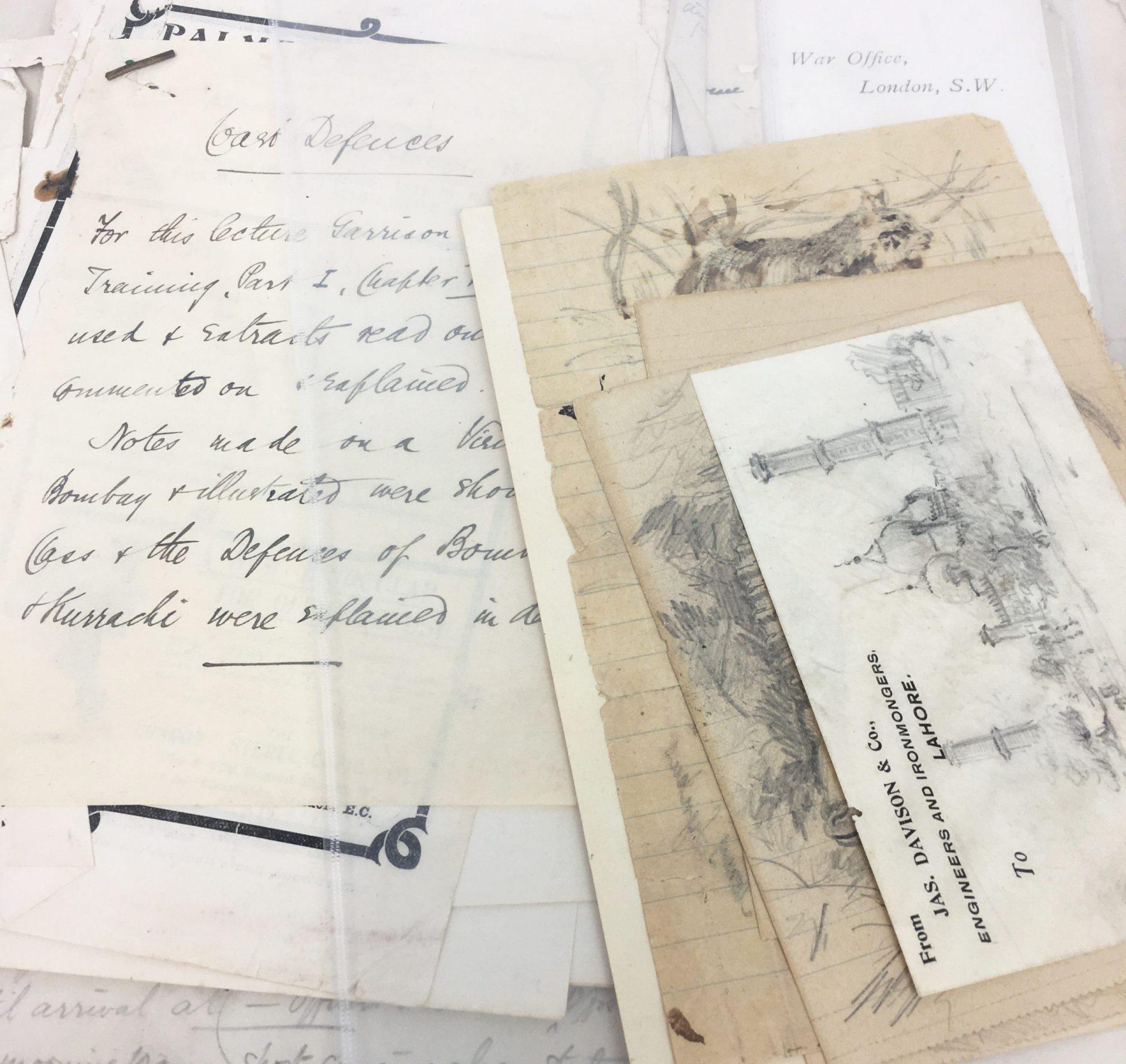
The unnumbered sections include “Relations between Intelligence Officers & Political Officers on the Frontier”, marked “Confidential”; “Coast Defences”; and ‘Afghanistan’ (August 15, 1910). Relating to military law there is also a proof printed chapter from a book, Chapter XII. Military Government, Discipline, Spies, Flags of Truce, Censorship and Captures. (Indian Supplement) marked “Draft” in manuscript.
Related to the course, but seemingly additional to the syllabus, Walshe conducted a series of studies regarding British India’s disputed frontiers with its neighbours, in particular the Chinese Empire (which had suzerainty over Tibet). These papers are fascinating contemporary accounts of one of the great geopolitical issues of the day, written by an insider with access to classified British intelligence. The studies occurred only a short time before the demarcation of the McMahon Line (1914), resolving the matter (at least for some years). These papers merit further academic study.
These manuscript and indigo copy documents include: “Indian Frontiers”; “Notes for N.E. Frontier, India / Lecture”; “North West Frontier”; and “Notes on the Burma-Yunnan border in connection with recent reports of Chinese activity” (India, 1910).
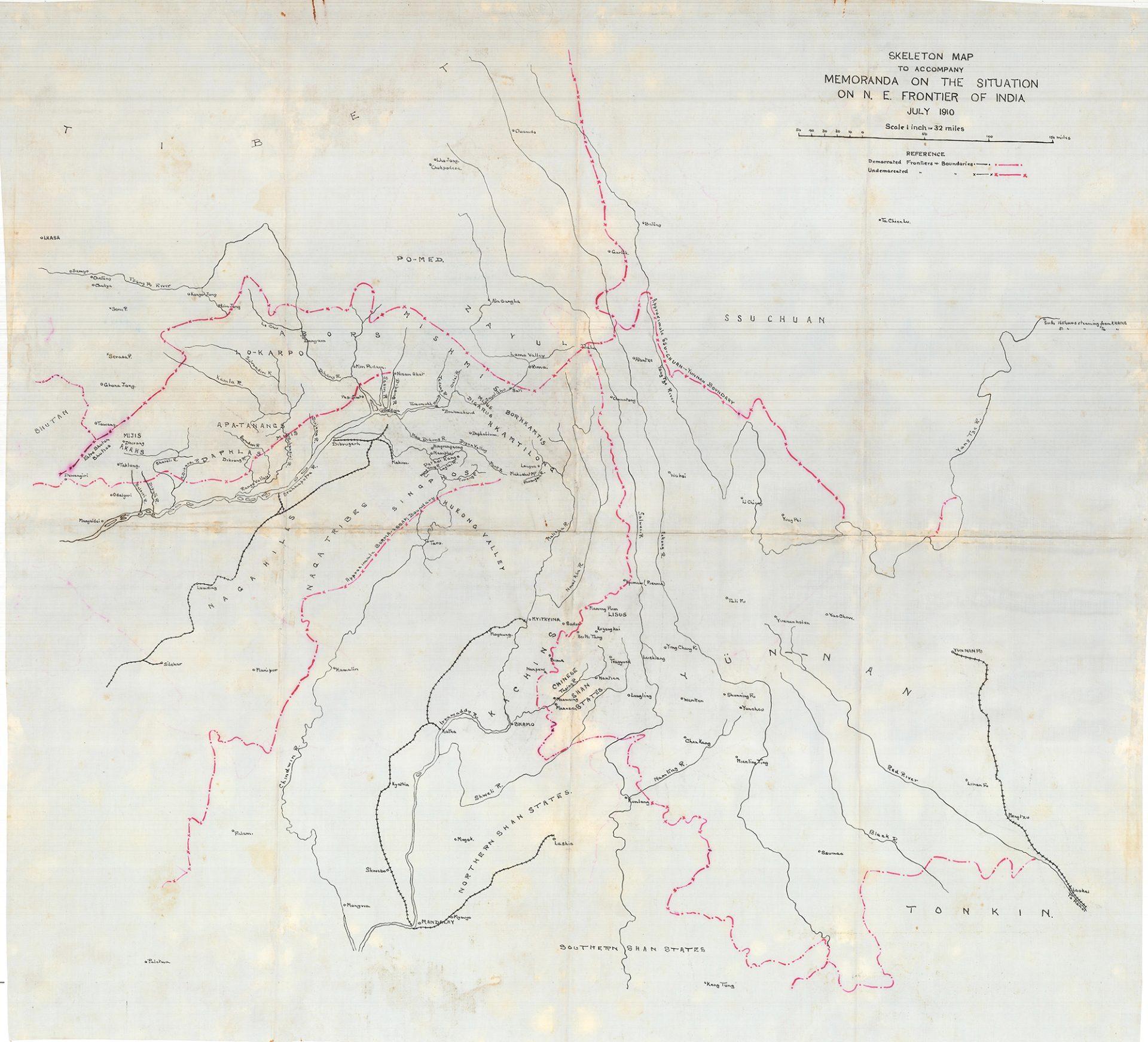
Additionally, there is Walshe’s manuscript “Notes on the N. & N.E. Frontier of E. Bengal & Assam” (India, 1910), that discussed the boundaries between British India (Burma, Arunachal Pradesh and Bengal) and China (Tibet and Yunnan), with the caveat written in pink pen at the top “Policy indicated is only suggested & had not been approved, possibly never will be”. To this study, Walsh attached his own large manuscript map:
“Sketch Map To Accompany Memoranda On The Situation On N.E. Frontier Of India / July 1910 / Scale 1 inch = 32 miles.”
India, July 1910.
Manuscript, black and pink pen ink on single-sided on waxed cloth paper (Very Good, old folds), 65 x 70.5 cm (25.5 x 27.5 inches).
The map clearly marks salient topographical details and infrastructure, as well as international frontiers, both “undemarcated” and “demarcated”.
PART IV: WALSHE’S DRAWINGS
Adding a personal touch, Walshe was an accomplished amateur artist, as well as a prize-winning big game hunter. Included here is a small collection of Walshe’s drawings of animals and landscapes, as well as a manuscript sketch of a mosque drafted upon on envelope from ‘Lahore’.
References: N / A – Archive seemingly unrecorded.

![SLAVICA / WWI IN TURKEY / DRINKING: [A copy from the report of the 2nd district of Kars, Commandant Lieutenant Ignatiev of Dec. 15th 1916, no 29 to the Commandant of the town of Kars. Court trial on Dec. 17th…]](https://pahor.at/wp-content/uploads/2022/08/Handschriftlicher-Text_2022-07-27_123043-265x331.jpg)

