
Description
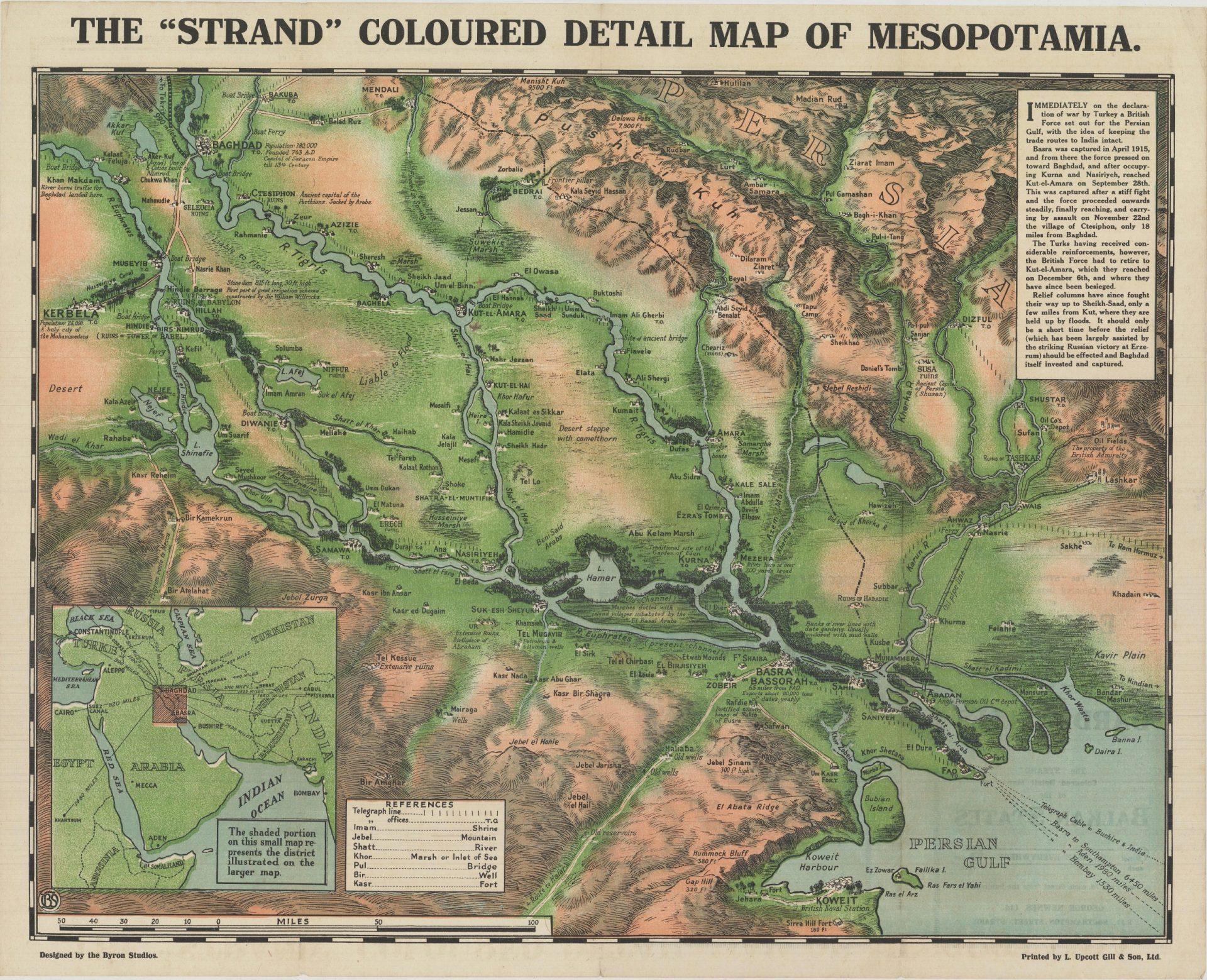
The present pictorial map showcases central and southern Iraq, Kuwait and southwestern Persia and was created in order to inform the general public on the theatre of World War I’s Mesopotamia Campaign, whereby British Imperial forces launched a full-scale invasion of Ottoman Iraq. The map was drafted with great skill by Byron Studios, a leading commercial art house, and was printed by George Newnes, Ltd., a publisher of top-selling popular magazines. It is certainly the most engaging work of its kind of the region we have ever encountered.
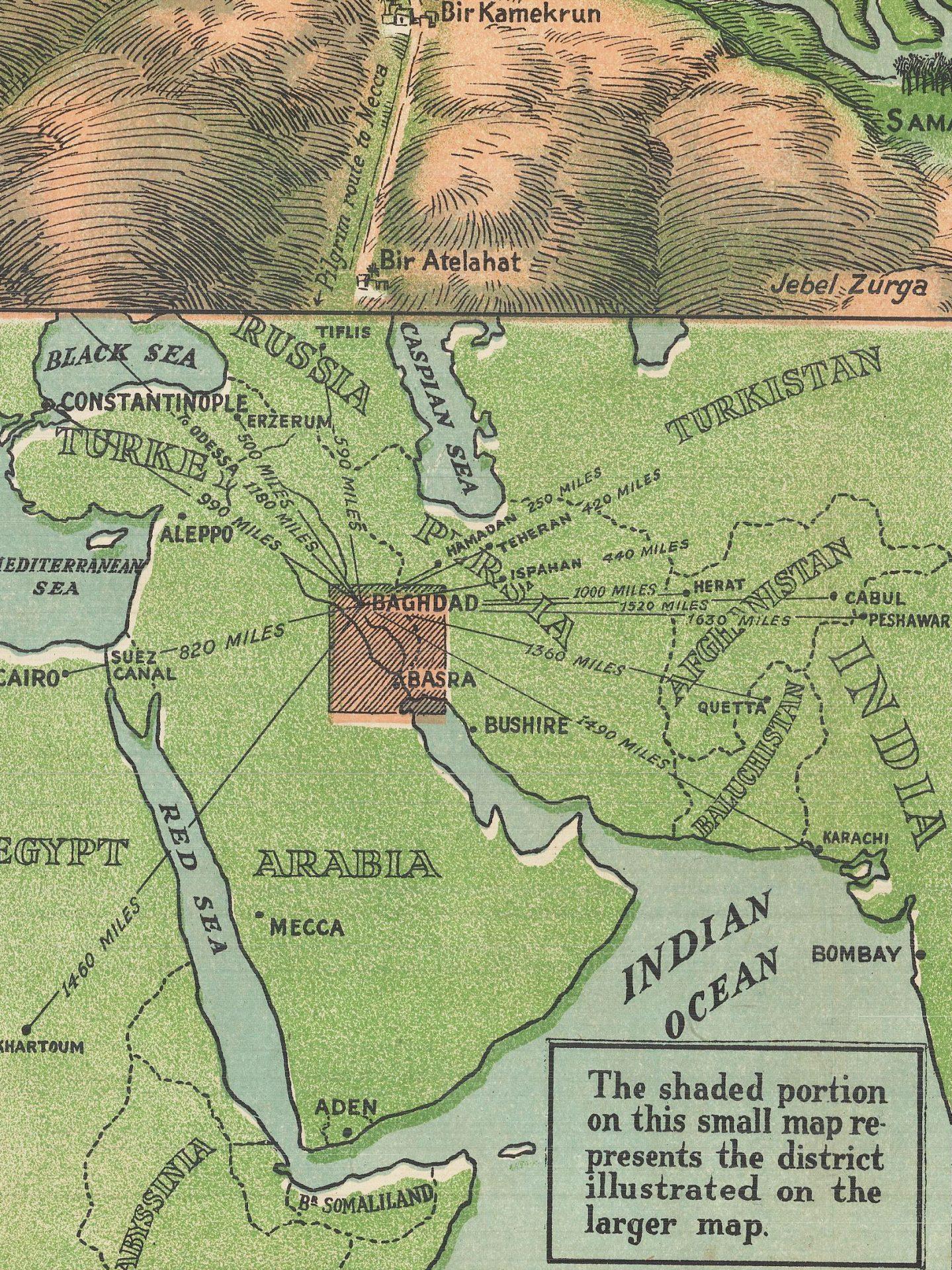
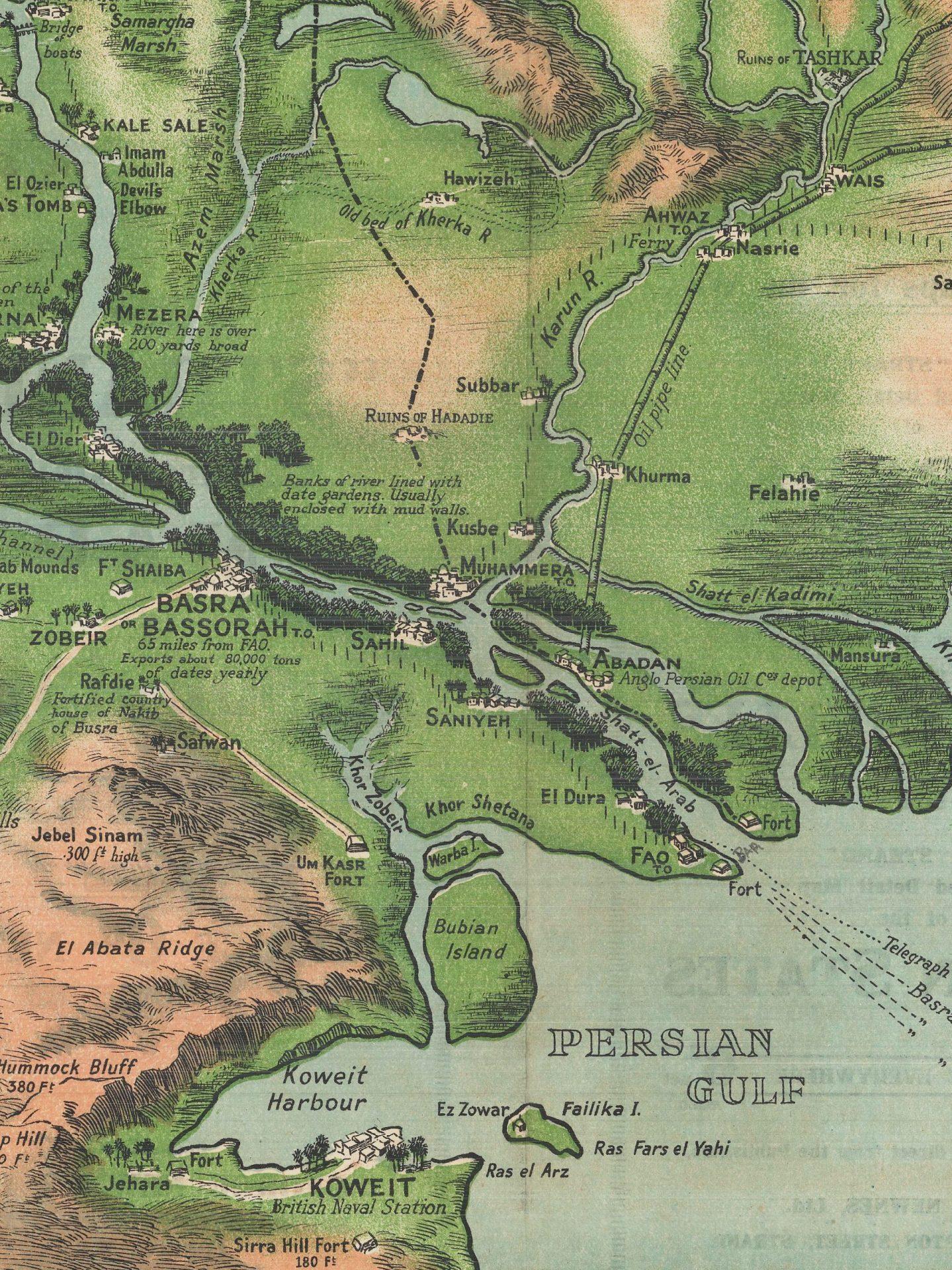
The map embraces all of Iraq from Baghdad south, as well as Kuwait (then a British protectorate) and the Khuzestan Province of southwestern Persia (then home to the first petroleum industry in the Middle East, controlled by official British interests). The region’s varied landscape is captured by the vivid draftsmanship, showing the lush, green lowlands of Mesopotamia, in between the dry mountains and deserts of Persia and Arabia, to either side.
Cities, towns and major sites are portrayed pictographically, with the ‘References’ in the lower left, explaining the symbols for Telegraph Lines (and offices), as well as translating the Arabic terms: Imam (shrine); Jebel (mountain), Shatt (river), Khor (marshes or sea inlets), Pul (bridge); Bir (well), and Kasr (fort).
As the region is one of the most culturally ancient and archeologically rich places on earth, as well as a global focus of political-economic interest, places throughout the map are described by numerous short notes. For instance, ‘Koweit – British Naval Station’; the featuring of an overview of the petroleum industry in southwestern Persia, ‘Abadan – Anglo Persian Oil Co’s Depot’ and the ‘Oil pipe line’ leading from the ‘Oil Fields – the Property of the British Admiralty’; ‘Baghdad – population 180,000, founded 763, Capital of the Saracen Empire till 13th Century’; the ‘Ruins of the Tower of Babel’ near Hindie; ‘Ruins of Babylon’ near Hillah; the ‘Pilgrim Route Mecca’, leading through the desert south from Najaf; ‘Stone dam 815 ft. long, 30 ft, high, first part of the great irrigation scheme constructed bs Sir William Willcocks’, plus, many more.
The present map was issued in early 1916, when the British forces, having made stellar progress in taking southern Iraq, failed to take Baghdad, and then found their main advance army surrounded by the enemy at the Siege of Al Kut (December 7, 1915, to April 29, 1916). While the narrative in the in upper right corner strikes an optimistic note, declaring that “it should only be a short time before the relief… should be effected and Baghdad itself should be invested and captured”, in reality the British would face a long and winding road to victory. The British forces at Al Kut were eventually forced to surrender, marking one of the worst military defeats in modern British imperial history. While the British would eventually take Baghdad (in March 1917) this was accomplished only after much hard fighting.
The Mesopotamian Campaign was of great interest to the British public, who thirsted for knowledge of the distant and mysterious region which was hitherto known to them only by its appearance in the Bible or in the odd newspaper article. The present map was commissioned by George Newnes, Ltd to show the campaign theatre in an engaging, and broadly accurate, fashion. It was, as the advertisement on the verso reads ‘On Sale Everywhere’ (mainly on newsstands) and was separately used for a price of 6 pence (7 pence with postage mailed directly from the publisher). The map was linked to the Newnes’s leading monthly magazine, The Strand, and was part of series of maps of the various WWI theatres, including The “Strand” Colored Detailed Maps… of Europe; the Balkan States; and the Dardanelles (the Gallipoli Campaign).
A Note on Rarity
The present map is very rare, which is not surprising as the survival rate of such fragile maps sold on newsstands is very low.
We can trace 5 institutional examples, held by the British Library (2 examples); Oxford University – Bodleian Library; National Library of Scotland; and the Royal Danish Library (Copenhagen). We are not aware of any sales records.
Espionage, Oil, War and the Contest for Mesopotamia
Mesopotamia, today known as Iraq, was the cradle of civilization in the Middle East and Europe, having over the millennia formed a key part of many empires. Since 1534, the region fell to Suleiman the Magnificent’s armies, becoming part of the Ottoman Empire. It was duly divided into the three vilayets (provinces) of Basra, Baghdad and Mosul. Mesopotamia was perhaps the most ethnically and religiously diverse part of the Middle East and Ottoman rule over the country was generally weak, with practical power invested in local leaders.
In the wake of the Napoleonic Wars, Britain aimed to expand its empire in India and to gain total dominance over the Indian Ocean. The Persian Gulf was viewed by Whitehall as vital to its strategic interests and, beginning in 1820, Britain began signing protectorate treaties with the Arab Gulf States, hitherto known as the ‘Trucial States’, which progressively allowed the Royal Navy to make the Gulf into a ‘British lake’.
Beyond its proximity the Gulf, Mesopotamia held a special place in the British mind. Those intellectually inclined were enthralled by the possibility of uncovering the archaeological wonders of the region, while figures of a more business-like disposition saw Mesopotamia as providing the key part of an overland route from Europe to India.
Beginning in 1826, members of the British Indian Navy, with the Sublime Porte’s reluctant permission (Britain was a key ally of Constantinople, albeit a meddlesome and exploitative one), commenced charting the notoriously treacherous Euphrates and Tigris Rivers in search of routes for steamships that would account for a critical stretch of the overland route.
Beginning in the 1850s, British Indian engineers commenced topographical surveys of the lowlands near the rivers, while also conducting rudimentary archaeological surveys. In the 1860s, the British proceeded to make surveys and set up telegraph lines in Mesopotamia, as part of an eventual rapid communications system connecting India with Berlin and London (via Persia and Russia).
Importantly, while these surveys were conducted for their stated purposes, they all had a dual role. The surveyors were all spies, under instructions to make observations on the land, the local people and the political and military situation, before presenting their findings to officials in both London and Calcutta. By the late 19th Century, Britain had a stellar knowledge of the region that was, in some respects, more comprehensive than that possessed by the Sublime Porte! British merchants in Basra and Baghdad also played a key role in the economy of the country.
To assert its control of the head of the Persian Gulf, in 1899 Britain recognized Kuwait as separate state from the Ottoman Empire. In 1914, Kuwait became a British protectorate, in a manner like the Trucial States.
Around the turn of the century, geologists were reporting that the Persian Gulf region was likely home to vast petroleum reserves. Oil was not only the key fuel for the next stage in the West’s industrial development, but if supplies enough to support the Royal Navy’s fleets to transition from coal to petroleum, it promised to give Britain an indomitable military edge.
With the signing of the Anglo-Russian Convention of 1907, whereupon Britain and Russia ended ‘The Great Game’, their decades-long cold war, Britain gained suzerainty over southern Persia.
In 1908, oil was discovered in Persia at Masjed Suleyman, in the Khuzestan region of southwestern Persia (labelled as ‘Masjid Suliman’ on the middle of the of the far-left side of the present map), and the British founded the Anglo-Persian Oil Company (APOC) to guard and exploit these discoveries (APOC was the precursor of today’s British Petroleum).
The British then turned their sights to Mesopotamia, which geologists believed contained massive petroleum deposits, in both the north (the Mosul and Kirkuk region), as well the far south of the country, near Basra (adjacent to Khuzestan). This sparked a massive surge in British interest in Mesopotamia, including a diverse array of megaprojects from irrigation schemes, to shipping lines, to mercantile enterprise and military reconnaissance missions. In a familiar refrain, all these endeavours were also espionage missions, with detailed intelligence being reported in a steady stream to Whitehall.
Enter Germany, which likewise possessed extensive interests in Mesopotamia. Since the late 1880s, it had worked to gradually displace Britain and France as the major foreign financial and military player at the Sublime Porte. Deutsche Bank, Kaiser Wilhelm II’s preferred financial vehicle, assumed control of the Orient Express (the famed rail route that connected Constantinople to the heart to Europe) and the Anatolian Railway, the uncompleted line that was to run across Turkey. In 1903, the Germans agreed to expand the Anatolian route through to Baghdad (and perhaps even Basra), creating the Baghdad Railway (German: Bagdadbahn), the envisaged Berlin-Baghdad Express. This line, if ever completed, would pose a terrifying threat to British interests in the Persian Gulf, especially the petroleum industry.
In 1912, the British backed the formation of the Turkish Oil Company to search for petroleum in Mesopotamia. This international affair curiously not only included British investors, but in an example of ‘keeping your enemies closer’, had Deutsche Bank as a major stakeholder, while the firm was headed by the brilliant Armenian tycoon and art collector Calouste Gulbenkian. Ironically, despite its name, the company did not feature the involvement of the Sublime Porte. While the venture showed enormous promise, the advent of the World War I ensured that any projects could not be realized for some years.
The outbreak of the Great War seemed to catch everyone in the Middle East a bit by surprise. However, the British, fearing for its interests in the Persian Gulf, had the Indian Army move quickly to invade Mesopotamia. In what became known as the Mesopotamian Campaign, the Indian Army arrived on scene in November 1914 and easily took Basra and most of the surrounding vilayet.
Importantly, during World War I both sides placed an incredibly high priority on obtaining geographic intelligence, especially in the Turkish-Middle Eastern theatres, where the topography was not so well known. The creation and acquisition of maps sufficiently accurate and detailed to aid military movement was often not only a supporting, but rather a decisive, factor upon tactical operations in theatres such as Gallipoli, the Sinai and Mesopotamia. The present map is one of the most consequential examples of the transference of geographic intelligence between sides during the conflict.
In 1915, the British gradually advanced up the Tigris and Euphrates valleys, scoring victory after victory against the Ottomans. However, they grew overconfident and overextended their lines. Meanwhile, the Ottomans received major reinforcements from Turkey (carried by the partially-completed Bagdadbahn, which could transport troops from Constantinople to Baghdad in only 21 days), while the Germans provided massive assistance in the form of sophisticated artillery and airplanes. Moreover, they dispatched Field Marshal Colmar Freiherr von der Goltz, better known as ‘Goltz Pasha’, the famed Prussian strategist and long-time military advisor to the Sublime Porte, to oversee the Central Powers’ efforts.
The British rashly attempted to take Baghdad but were defeated by the reinvigorated Ottoman-German forces at the Battle of Ctesiphon (November 22-25, 1915), only 35 miles south of the city. The main British force under Major-General Charles Townshend was then driven south to the strategically important (yet vulnerable) town of Kut-al-Amara, located on a bend in the Tigris, about 160 miles south-east of Baghdad (in upper centre of the map). The town was encircled by Goltz Pasha and the Ottomans, commencing the Siege of Kut (December 7, 1915 to April 29, 1916). After almost five months, the starving British garrison surrendered to the Ottomans. In what was one of the greatest Allied defeats of the war, only 13,164 of the original 45,000 British imperial troops had survived the siege (while most of these men subsequently died during the POWs’ ‘death march’ to Anatolia). This was not only a devastating blow to British pride and morale, but for a while it threatened to cause the many of the hundreds of millions of Muslims living in the British Empire to question their loyalty to the seemingly flagging Allied case.
Later in 1916, the British were determined to recover and avenge their defeat, sending massive reinforcements to Mesopotamia commanded by a vigorous new leader, Lieutenant-General Sir Stanley Maude. Meanwhile, the death of Goltz Pasha, due to cholera, on April 19, 1916, was a great blow to the Ottoman-German effort.
Beginning in December 1916, Maude’s force methodically made its way up the Tigris and Euphrates. The British spooked the Ottomans into retreating, abandoning Baghdad to Maude on December 11, 1917. Henceforth, the British continued their conquest northward, albeit slowly. While World War I in the Ottoman lands ended upon the Armistice of Mudros (October 30, 1918), in contravention of the agreement, British forces continued to move north, taking Mosul on November 14, 1918 (so giving British control of the most promising potential petroleum region!).
The Treaty of Versailles (1919) hailed the dissolution of the Ottoman Empire and made Iraq into British-controlled mandate (essentially a protectorate). The Turkish Petroleum Company ramped up its exploration ventures, discovering the massive Kirkuk fields in 1927. Renamed the Iraq Petroleum Company in 1929, the firm went on to discover many new oil fields, including in the Basra region, located on the present map. While Iraq technically became independent in 1932, Britain continued to dominate its politics and oil production until the July 14 Revolution of 1958 brought in a nationalist republican regime opposed to Western hegemony.
References: British Library (2 examples): Cartographic Items Maps 48495.(19.) and Cartographic Items Maps 48495.(20.); Oxford University: Bodleian Library: D19:8 (3); National Library of Scotland: Map.s.36.10; Royal Danish Library (Copenhagen): UB1 Gl. Samling, Til hjemlån (skal bestilles) As. 12550 8°; OCLC: 465804601, 556590225, 863254223.

![RAF WWII AIR NEWSPAPER: Zmaga. Zavezniška publikacija za Jugoslovane. Posebna izdaja [Victory. Allied Publication for Yugoslavians. Special Edition].](https://pahor.at/wp-content/uploads/2020/06/65224-265x331.jpg)


Reviews
There are no reviews yet.