
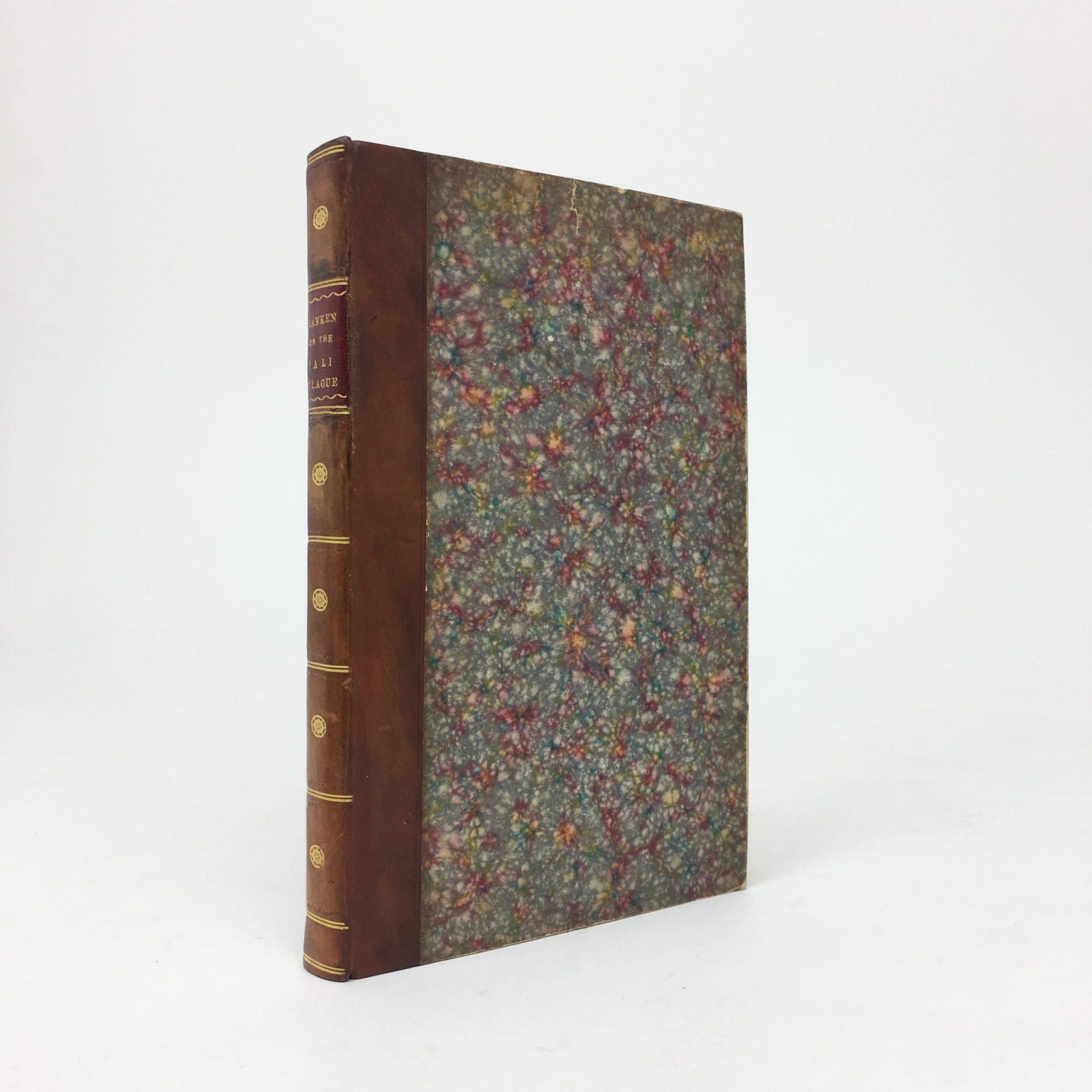
Description
India, due to its generally warm climate and dense population, had since ancient times been perhaps the greatest incubus for infectious diseases in the world. It was not uncommon for epidemics, some never encountered before, to suddenly develop and quickly carry away hundreds of thousands of people. Traditionally, many accepted the bouts of disease as divine will, and did little to combat the scourges (which were admittedly well beyond the capabilities of contemporary medicine).
Cholera had its origins in Bengal in 1817 and would rage around the world in a series of pandemics. The leaders of the British colonial regime India were chastened by their experiences with cholera and horrified by the regular toll that various other epidemics wrought up the people and economy of the lands they governed. Serious scientific resources were directed towards identifying, analyzing, controlling and treating infectious diseases in India, and the resulting discoveries played a major role in establishing the foundation of modern tropical medicine.
In July 1836, a highly infectious pulmonary disease broke out in the village of Pali, Marwar Rajasthan (then called Rajpootana). The so-called ‘Pali Plague’ had a high mortality rate and within only a few months spread to 24 other villages within a 30-mile radius, reaching the major city of Jodhpur in October. While the illness receded somewhat during the dry season, it was revived whenever the weather turned colder or rainier. Diagnosing and controlling the epidemic was complicated by the concurrent outbreaks of yellow fever and other contagious diseases in the immediate vicinity. The contagion skipped over the ‘Mhairwah Hills’, infecting regions to the west and southwest of Marwar, while major cites had to be cordoned off, quarantined from the outside world. With the cooperation of the rulers Jodhpur and Udaipur, the British military erected cordons to prevent the spread of the disease. The Pali Plague eventually died out in 1838, but only after killing an estimated 100,000 people.
The Pali Plague bore resemblance to several other outbreaks of infectious pulmonary diseases in other parts of India over the years, and one factors that seemed common to several of the epidemics was that they followed the sudden mass deaths of livestock or rats.
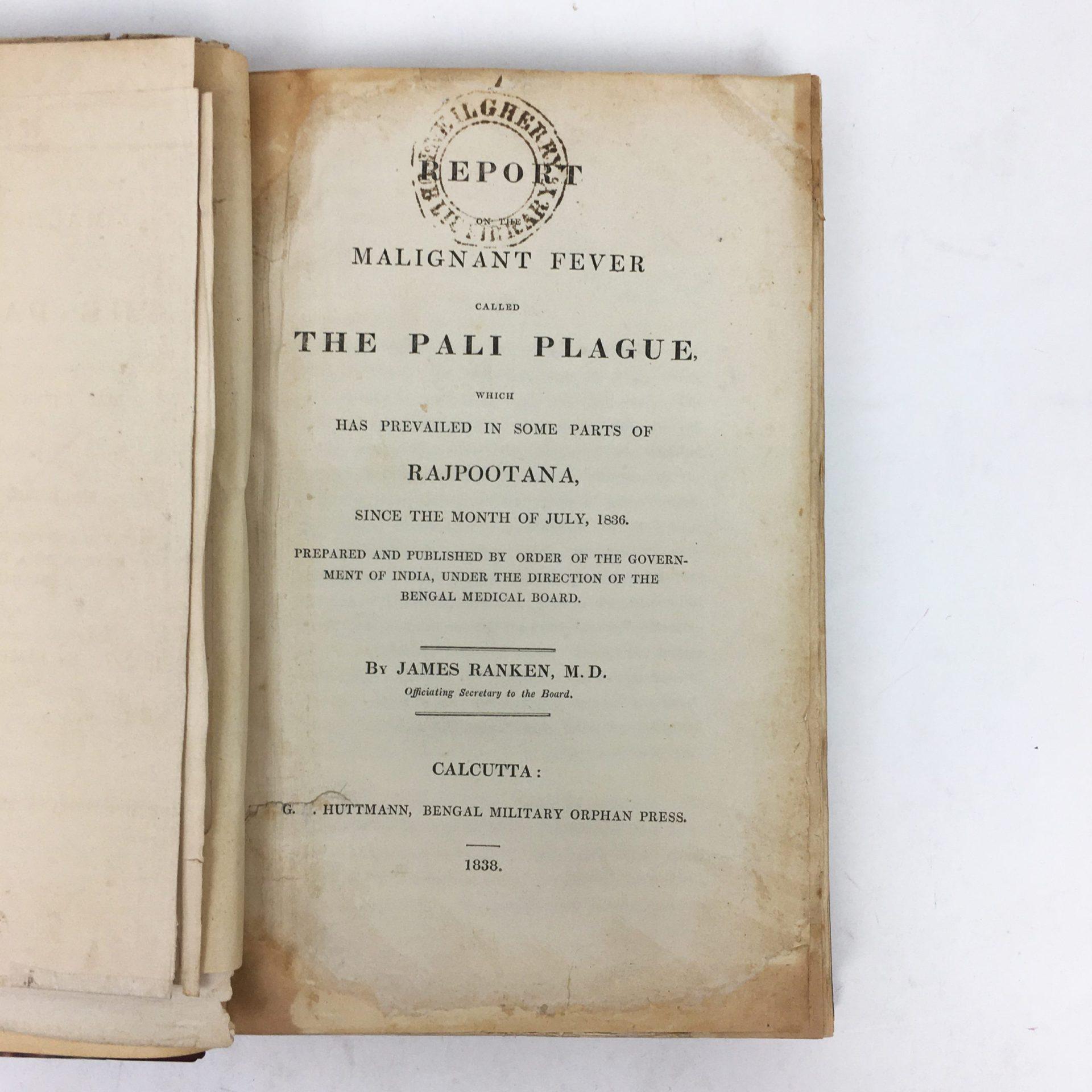
The present work was written after the worst of the Pali Plague had passed, but before it had fully run its course. The Government of Bengal, as well as the local rulers, were deeply concerned, and medical doctors were sent to the region to analyze and manage the disease, as it was unfolding. The goal was to create a comprehensive scientific study the Pali Plague such that it could be contained, and hopefully treated, while lessons could be learned to subdue expected future epidemics of a similar nature.
The physician James Rankin was charged by the Bengal Government with compiling and analyzing the best available information on the Pali Plague, generally gathered from original correspondence written by doctors and crown officials in the field. The present work is the result.
Rankin divides the body of the report into 5 sections: 1) History of the Disease; 2) Symptoms of the Disease; 3) Origin and Causes of the Disease; 4) Cure of the Disease; 5) Prevention of the Pali Disease and other Malignant Fevers in India. This is followed by a comprehensive and valuable collection of the most important primary sources.
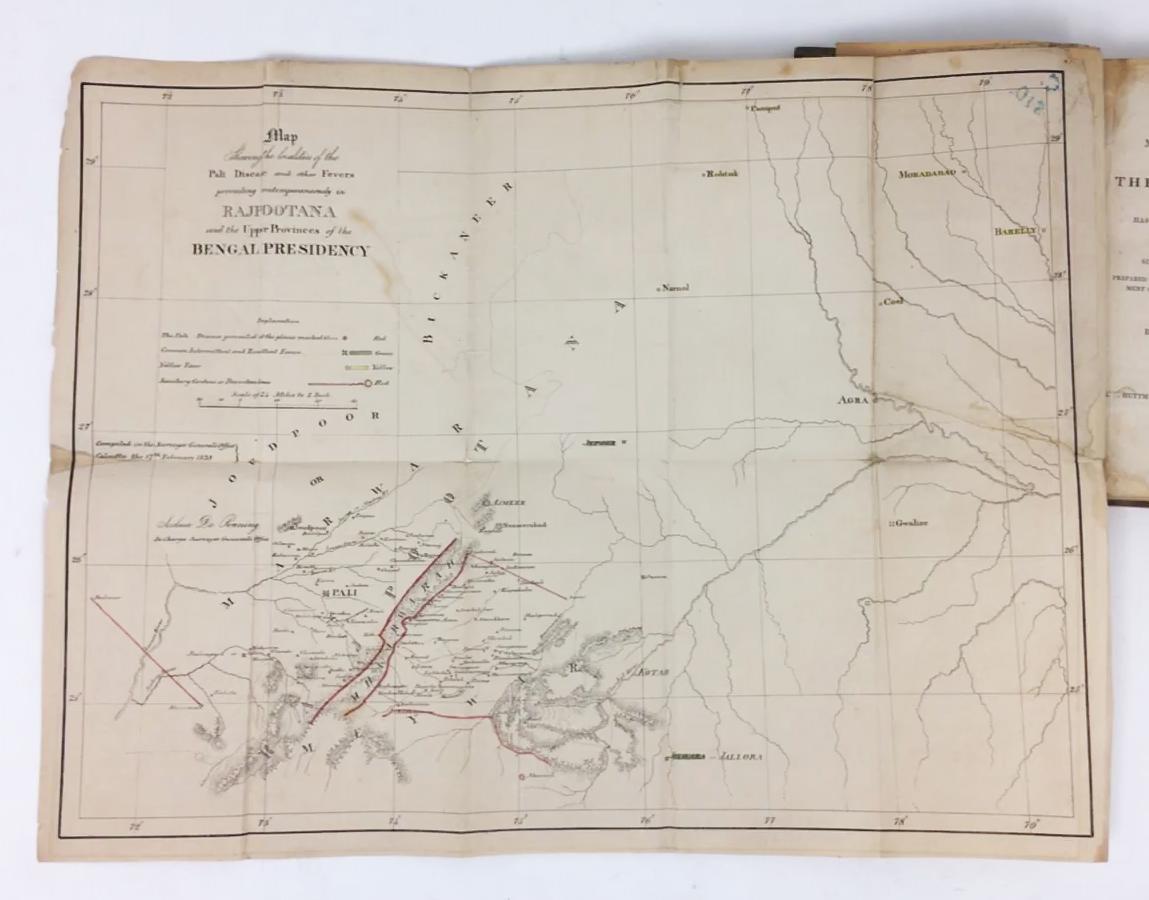
Perhaps the highlight of the work is the stellar ‘Map Shewing the localities of the Pali Disease and other Fevers prevailing contemporaneously in Rajpootana and the Upper Provinces of the Bengal Presidency’ (measuring 43 x 56.5 cm), a masterpiece of early medical cartography. Cited as having been ‘Compiled in the Surveyor General’s Office, Calcutta 17th February 1838’, if focusses upon the heart of ‘Rajpootana’ (Rajasthan), a region of princely states that maintained friendly relationships with the British colonial regime. The core are is framed by ‘Jypoor’ (Jaipur), in the northeast, ‘Joupoor’ (Jodhpur), in the west, with ‘Ajmeer’ near the middle, and ‘Jilwara’ (Jhalawar), in the southeast.
The ‘Explanation’, below the title, identifies the colours and symbols employed to indicate: ‘The Pali Disease prevailed at the places marked thus’ (Red Dots); ‘Common Intermittent or Remittent Fevers’ (Green); ‘Sanitary Cordons or Preventive lines’ (Red Lines and Red Dots around Cities).
The epicentre of the disease was in Pali, Merwar, within a region filled with red dots (including the major city of Jodhpur), while a separate major area of infection is shown to the east. The military’s main quarantine cordons are shown to guard the ‘Mhairwarah Hills’ (in order to prevent cross-infection between the main areas), with other cordons to the southwest, northeast and southeast; while the cities of Ajmer and Nuseerbad are cordoned off. Yellow fever is shown to plague the far northeast, outside of the main Pali Plague areas.
Rankin’s report is an extremely valuable record of the Pali Plague, an epidemic that was closely related to a number of other infectious diseases that would haunt the world over the coming generations. The work is still often cited in academic literature even to the present day, on the history of epidemiology, and pulmonary illnesses in particular.
A Note on Rarity
There seems to be about 10 examples in institutions. The work is very rare on the market, we cannot trace any sales records.
Interestingly, the present example of the work was once in the collections of the famous Nilgiri Library, located in the hill resort of Ootcamund (today Udagamandalam); the library was legally deaccessioned following Indian Independence.
References: British Library: 7561-g-47.; OCLC: 504462864, 457510281,14846458; Alex CHASE-LEVENSON, The Yellow Flag: Quarantine and the British Mediterranean World, 1780–1860 (2020), pp. 232-234; SASHA, Social History of Epidemics in the Colonial Punjab (2014), p.195; Medical and Physical Society of Bombay of the Year M.DCCC.XL (Bombay, 1840), p. 186; The Medico-chirurgical Review, and Journal of Practical Medicine (1839), pp. 112-115.
![ARMENIAN HISTORY: ՀԱՅՈՑ ՊԱՏՄՈՒԹԻՒՆ: ՀԻՆ ՀԱՅԵՐ: Ա։ ՀԱՏՈՐ [Armenian History: Old Armenians. Volume I]](https://pahor.at/wp-content/uploads/2020/06/img_1605-265x331.jpg)

![ESPERANTO – LITHUANIA: Litovaj popolkantoj [Lithuanian Folk Songs].](https://pahor.at/wp-content/uploads/2020/06/65495c-265x331.jpg)

Reviews
There are no reviews yet.