
Description
Spain had long maintained a fixed presence in northern Morocco, controllin the exclaves of Melilla (since 1497) and Ceuta (since 1580). In 1860, Spain fought a brief war against Morocco, resulting in Ceuta being given extended boundaries. In 1884, Madrid formally declared the north coast of Morocco as a Spanish zone of influence, even it did not really control most of the area.
In an arrangement brokered by Britain, as a corollary to the Entente Cordiale (1904), it was agreed that most of Morocco would become a French colonial sphere, while the northernmost part of country would be under Spanish auspices. At the Treaty of Fez (1912), the Moroccan sultan and France both agreed that Spain would henceforth have formal control over northernmost Morocco, becoming the Protectorado español en Marruecos, with Tétouan as its capital (Tangiers was excluded from the protectorate, becoming an international city in 1923).
The Berber tribes of the Rif Mountains which rose over the Mediterranean littoral of Spanish Morocco were never reconciled to the new colonial regime. Indeed, the Rifians had had always maintained their autonomy from the Moroccan crown and were not about to surrender their freedom to foreign interlopers. When the Spanish began to press into Rifian territory to gain access the region’s abundant iron deposits, the locals pushed back, creating serious tensions.
Eventually, the Rifians had enough, and organizing themselves, they mounted a mass rebellion known as the Rif War (Guerra del Rif, 1921-6). Led by the brilliant guerrilla leader Abd el-Krim, the insurgents declared the bulk of Spanish Morocco to be the ‘Republic of the Rif’.
Spain took the rebellion seriously and sent a sizable force under General Manuel Fernández Silvestre, a favourite of King Alfonso XIII, to quell the insurgency. However, Abd el-Krim’s daring, lightening stealth tactics scattered and smashed the lumbering Spanish army at the Battle of Annual (Desastre de Annual, July 22, 1921), killing over 13,000 Spanish troops, and forcing what little remained of their force to retreat to Melilla.
To make matters worse, at the Massacre of Monte Arruit (August 9, 1921), the Rifians slaughtered 2,000 Spanish troops – after they had surrendered. While the massacre was committed against the express orders of Abd el-Krim, the incident enraged the Spanish public who would never forgive the Rifians for what they say as a cowardly, perfidious crime.
The shock of the ‘Desastre’ and the Massacre rocked Spain, being amongst of the main causes of the 1923 military coup that brought the dictator Primo Rivera to power.
In Spanish Morocco, the king’s forces limped on, proving themselves incapable of defeating Abd el-Krim’s men, who continued to control much of the countryside. In due course, Rivera came to believe that the cause in Morocco was so great that in October 1924, while still holding the office of prime minister, he went to the Rif to personally lead the counterinsurgency.
In May 1925, the over-emboldened Rifians attacked the French border cordon that lay the south of Spanish Morocco, overwhelming these positions, and compelling France to join the conflict on the side of Spain.
France and Spain decided that the Rif War had to be won at all costs, not just to save their possessions in Morocco, but to defend the continued existence of European imperialism in general. The allies made quite a show of force upon mounting the Alhucemas Landing (September 8, 1925), the first amphibious landing in history involving the use of tanks and airplanes. Soon the allies flooded northern Morocco with over 250,000 troops (160,000 French, 90,000 Spanish).
Month of intense combat followed, during which the allies used chemical weapons. Despite the brilliance and dedication of the Rifians, they were no match for the Franco-Spanish juggernaut, and Abd el-Krim was compelled to surrender on 26 May 1926, so ending the war.
Spain was victorious, and it would securely control its northern Morocco protectorate for the next 30 years, until all Morocco was given its independence in 1956 (although Spain has retained Melilla and Ceuta to the present day). However, the Rif War had been atrociously costly for Spain in both blood and treasure. Their forces suffered 53,000 casualties, while the trauma and near catastrophe of the conflict fatally wounded the Spanish monarchy and destabilized the country, leading to the Spanish Civil War (1936-9).
Yet, in 1927, the General Staff of the Spanish Army was in the mood to celebrate their forces’ hard-won victory, leading to the creation of the present map.
The Map in Focus
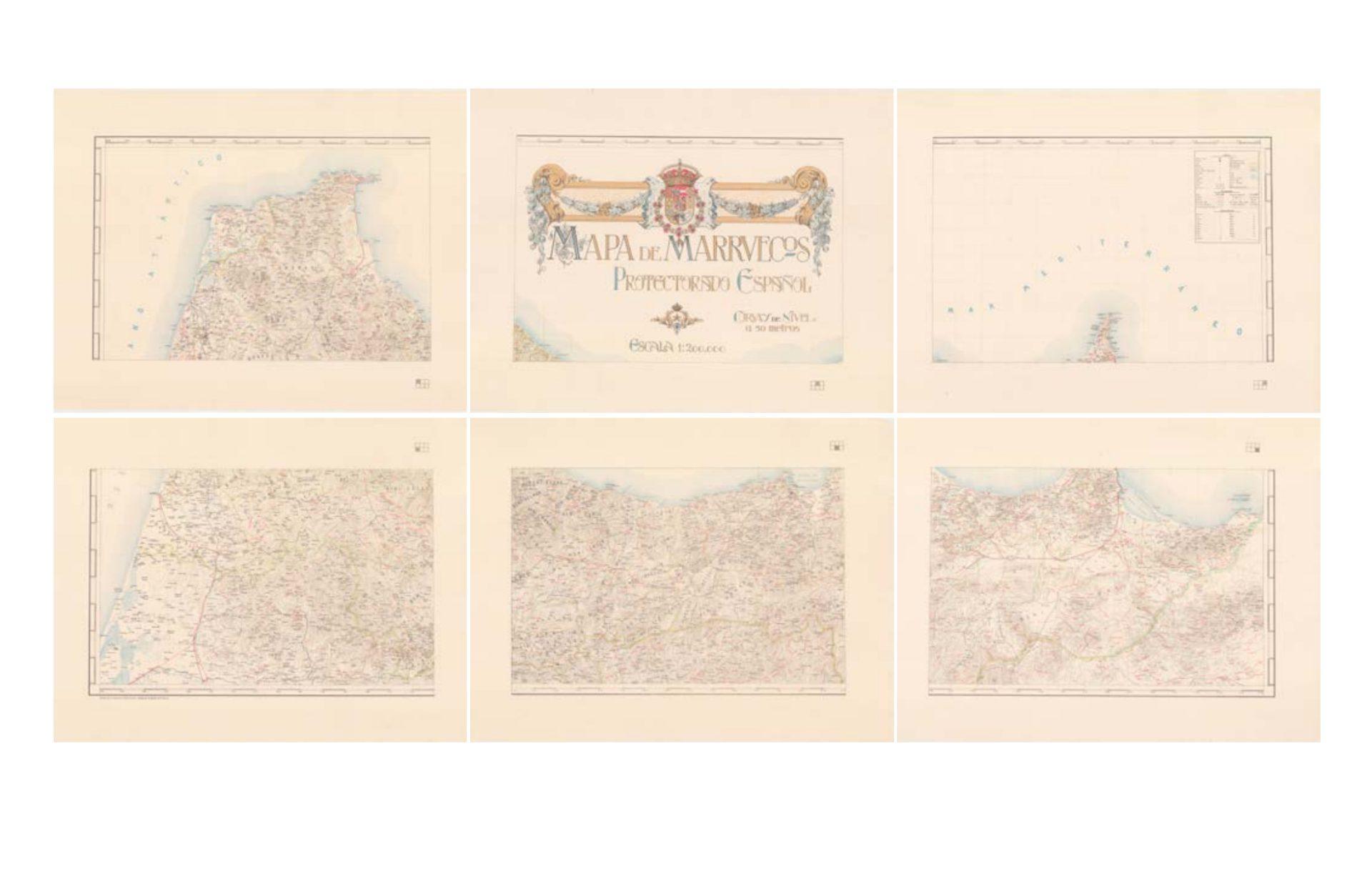
This is almost certainly the most beautiful and impressive map ever made of Spanish Morocco. It was created in December 1927 by the Cuerpo de Estado Mayor del Ejército (General Staff of the Spanish Army) and printed in Madrid by the Talleres del Depósito de la Guerra, the army’s publishing division.
The giant 6 sheet map (that if joined would measure approximately 100 x 205 cm) is surmounted by flamboyant cartouche featuring the Spanish royal arms and is executed to an ample scale of 1:200,000. The photolithography employed is of the top quality and the colours are resplendent, while the topography is predicated upon the best and most recent scientific surveys. Thus, the map, being both decorative and practically useful, was clearly intended to be a graphic manifestation of Spain’s ‘triumph’ in the Rif War.
The map features a vast wealth of detail, as explained in the ‘Signos’, in upper left corner of Sheet 3, featuring the symbols used to identify European towns; Moroccan villages; souks; mosques; isolated houses; military positions or European camps; aerodromes; lighthouses; anchorages; Moroccan tent encampments; roads; highways; railways; bridges; the Line of the 1912 Treaty; district boundaries; contour lines (at 50 metre intervals); rivers; arroyos; lagoons, swamps, canals; springs; wells; and ‘Officinas de Intervención’ (Spanish colonial offices). The chart of ‘Abreviaturas’ below explains the shorthand used to describe topographical terms.
While billed as an “Edición provisional”, the highly finished map appears to be the only edition of work.
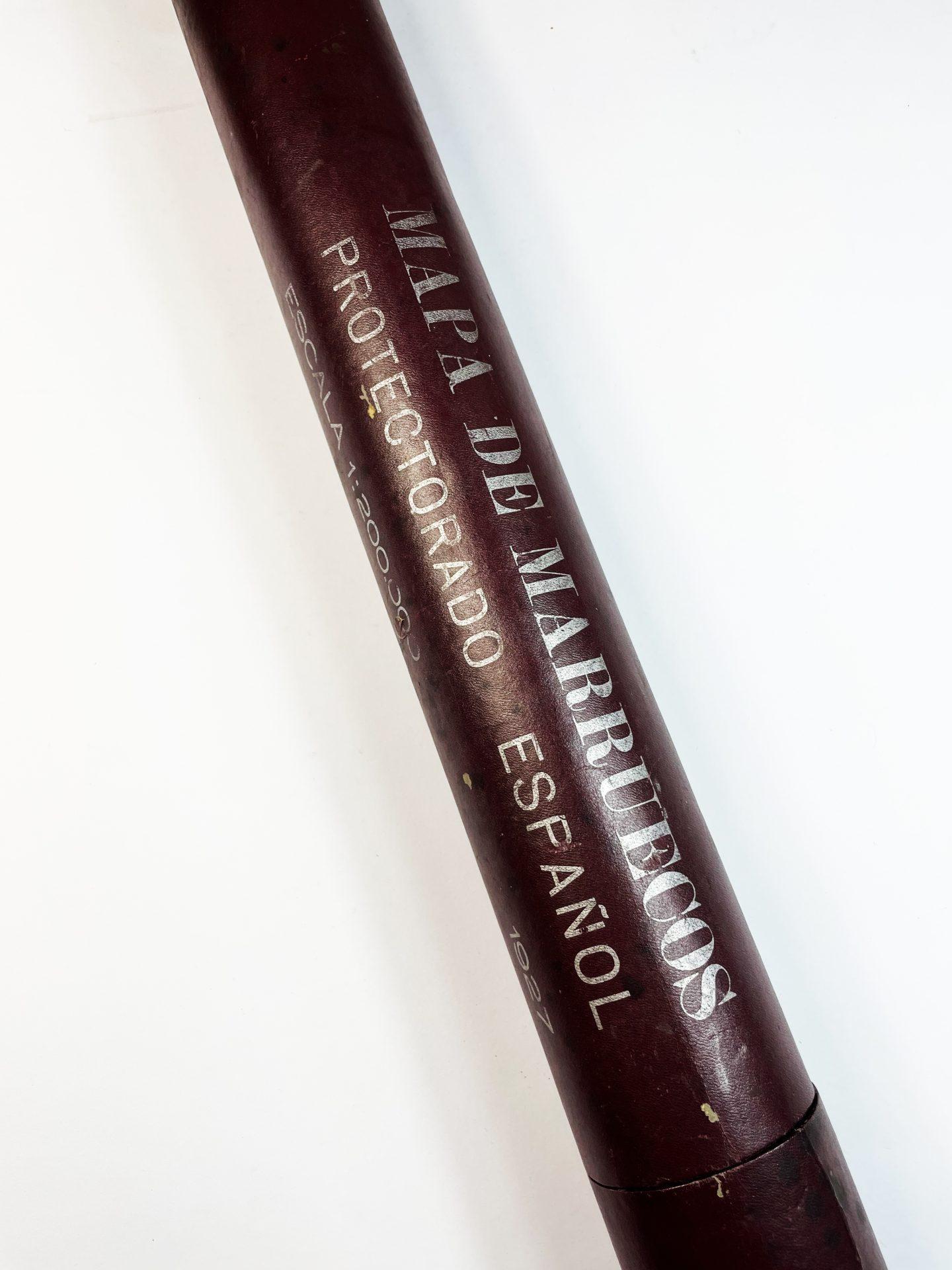
The present example of the map is marquis, for it is not only in stellar condition, but it features the original crimson, silver lettered card tube in which it was issued.
Curiously, the manuscript upon which the map is based survives today in the collections of the Archivo Intermedio Militar de Ceuta. It appears to be similar to the printed map, save that it shows the lines of advance of the Spanish-French forces during the latter part of the Rif War. This manuscript was recently displayed as part of an exhibition in Ceuta, Estructura Militar en el Protectorado español de Marruecos y Territorios de Soberanía en África (2022).
A Note on Rarity
The map is rare. We can trace examples held by 9 institutions, including the Biblioteca Nacional de España (6 examples); Instituto Geográfico Nacional (Madrid); AECID Biblioteca; Universidad Castilla-La Mancha; Consejo Superior Investigaciones Científicas; British Library; Bodleian Library (University of Oxford); Bayerische Staatsbibliothek; and the Leiden University Library. Complete examples in good condition seldom appear on the market, and the present offering is unusually fine.
References: Biblioteca Nacional de España (6 examples): AFRMPS/11/12, AFRMPS/11/13, MR/14/176, MR/14/177, MR/33-41/1707, MV/30 (ROLLO 11); Instituto Geográfico Nacional (Madrid): S1-148-L-30; British Library: Maps Y.556.; Bodleian Library (University of Oxford): E23:1 (29); Bayerische Staatsbibliothek: Mapp. XX,63 gi; Leiden University Library: COLLBN 004-09-032/037; OCLC: 1381232550, 1026157444, 71505325, 497889023, 863603422; COMISIÓN HISTÓRICA DE LAS CAMPAÑAS DE MARRUECOS, Geografía de Marruecos, protectorados y posesiones de España en Africa (1935), p. 195; Rodolfo GIL, Aproximación a una bibliografía española sobre el norte de Africa, 1850-1980 (1982), p, 501; La Géographie, vols. 55-56 (1931), p. 421; Joan NOGUÉ I FONT and José Luis VILLANOVA, España en Marruecos (1912-1956): discursos geográficos e intervención territorial (1999), p. 297; ROYAL GEOGRAPHICAL SOCIETY, Recent Geographical Literature, Maps and Photographs, vol. 3 (1928), p. 166.
![TURKEY – STATISTICAL MINING ATLAS: معدن احصائياتي اطلاسي [Maden Ihsaiyati Atlasi / Mining Atlas of Turkey].](https://pahor.at/wp-content/uploads/2020/06/65777s-265x331.jpg)


