
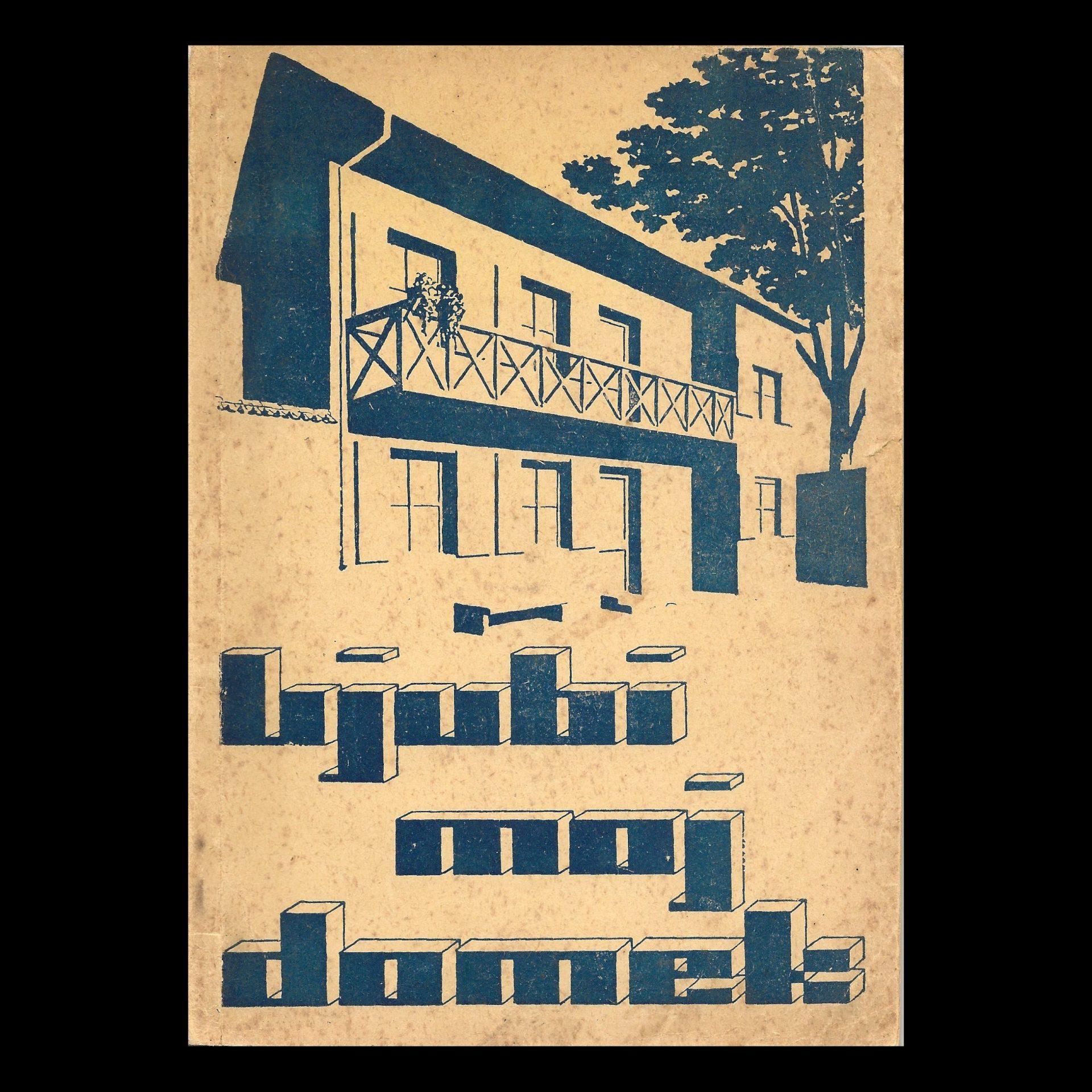
Description
A book with a stunning futurist cover design was written in Slovenian language in 1933 in Fascist Italy by a Slovenian female writer Davorina Bratuž, here signed with nom de plume Marina Seljak. The text, accompanied by illustrations, includes instructions on interior decoration and household, promoting the modern minimalistic functional art deco design. Bratuž also introduced a modern way of lining, which reflects on the interiors, such as separate bedrooms for a busy couple.
The books by this publishing house usually bore more or less obvious hidden anti-Fascist messages or plots, which could not be easily detected by Italian censorship, such as stories about simple people standing against the government and illustrations including the partisan stars. In this case the tile My Dear Little Home could refer to the interior decoration or could be interpreted as a patriotic parole. The author’s next publication with another title with a double entendre, Insects in the House, which could
refer to exterminating the insects or could be also associated with the Fascist in the Slavic land, was forbidden by the censorship.
From the 1920s until the capitulation of Italy in 1943 the Slavic speaking population in Fascist Italy developed a closely knitted network of supporters and creators of public anti-Fascist propaganda, such as painted murals inside churches and printed books, which were accessible to public, but not noticeable by the Italian censorship.
The author Davorina Bratuž (1894-1971) was a author and artist. She was also a partner and later wife of the director of the Goriška matica publishing house France Bevk, who was one of the most active Slovenian authors of the 20th century. As anti-Fascist activists they were sent to prison and both joined the partisans in 1943 after the capitulation of Italy.
The cover design was possibly made by Ciril Cej (1887 -1971), an author and technical drawer, active at the Goriška matica publishing house. Cej only rarely signed his work with his initials and was using a nom de plume Jakob Trnovec for his written works (see the next item).
Goriška matica – The Last Slavic Press in Fascist Italy
Goriška matica was a publishing house, founded in Gorizia (today Italy) on territory annexed to Italy after WWI. It was specialized in publishing Slavic, mostly Slovenian books.
Until WWI, the territory with a major Slavic population, belonged to Austro-Hungary. After the war the territory was annexed to Italy, exposing the Slavic inhabitants to growing Fascist power, which during the 1920s started suppressing the Slovenian and Croatian language.
Matica in Goricia, run by the Slovenian intellectuals from the region and with a printing press Edinost (Unity) in Trieste, was one of the last Slavic publishing companies, fighting to keep the native language. By the late 1920s all the publications of the press had to undergo a Fascist censorship and hundreds of thousands of books were destroyed. In 1933 the publishing house had to Italianize its name to Unione editoriale Goriziana, and was eventually closed in 1940.
The publications of Goriška matica in the 1920s and 1930s were known for good quality texts of the contemporary Slavic authors from the region of Gorizia, Trieste and Karst, and well-designed modern covers, made by academic artists and modern designers.
We could not find any institutional copies outside Slovenian libraries on Worldcat.
References: OCLC 444656662. Brecelj, Marijan: Bevk, Davorina (1894–1971). Slovenska biografija. Slovenska akademija znanosti in umetnosti, Znanstvenoraziskovalni center SAZU, 2013. http://www.slovenskabiografija. si/oseba/sbi1002160/#primorski-slovenski-biografski-leksikon (10. avgust 2018). Izvirna objava v: Primorski slovenski biografski leksikon: 2. snopič Bartol – Bor, 1. knjiga. Uredniški odbor Gorica, Goriška Mohorjeva družba, 1975.


![ESPERANTO: De paĝo al paĝo. Literaturaj profiloj [From Page to Page. Literary Profiles].](https://pahor.at/wp-content/uploads/2020/06/65481-265x331.jpg)

Reviews
There are no reviews yet.