
Description
Borodino was a German agrarian colony that existed from 1814 to 1940 in Bessarabia, a region that is today divided between the Republic of Moldova and Ukraine. The Germans were incentivized to establish such colonies by the Russian Czar Alexander I, and over the following decades they formed small and self-contained, but successful German mini-societies within a greater ethnic Slavic-Romanian realm. However, in the early part of World War II, pursuant to the Molotov-Ribbentrop Pact and the Soviet conquest of region, the ‘Bessarabian Germans’ were compelled to leave their colonies, albeit in an orderly fashion with the assistance of the Third Reich, for new homes in German-occupied Poland.
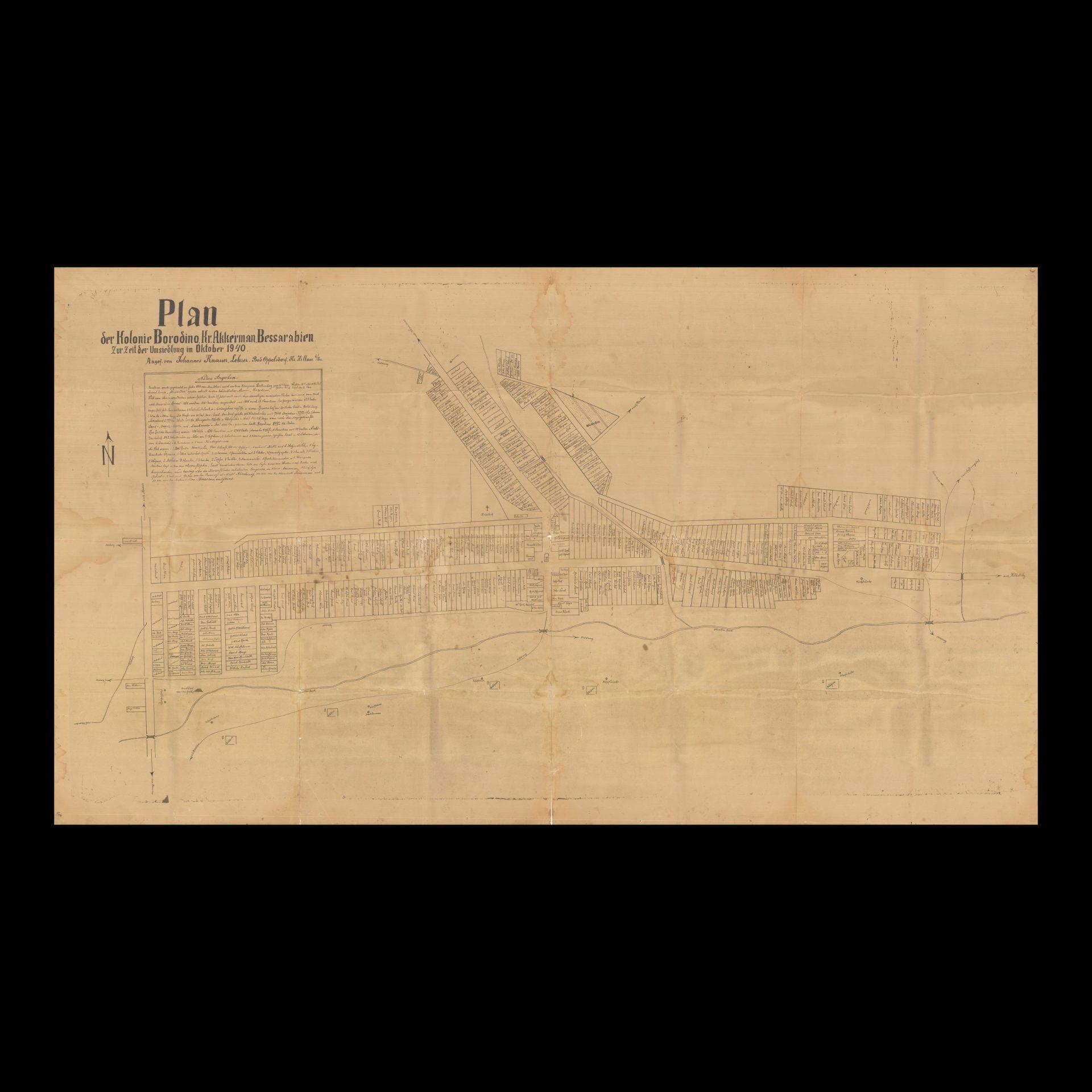
The present colossal map shows Borodino in unprecedented detail, as it appeared in October 1940, during the final hours of the existence of the German colony, just as its residents were preparing to leave for their new homes.
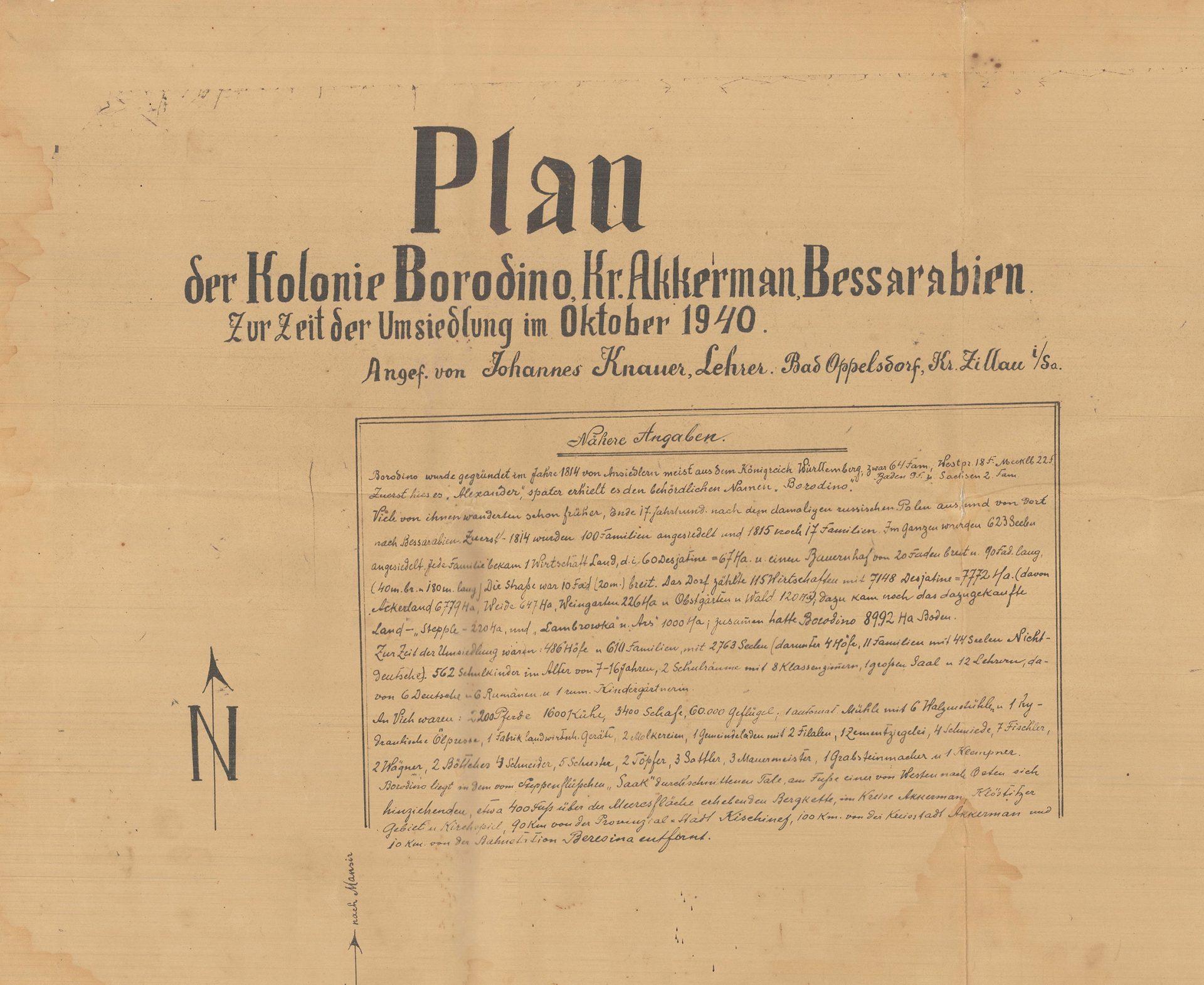
The present map was photolithographed after a manuscript map, probably in the town of Bad Oppelsdorf, Saxony (today Opolno-Zdrój, located in extreme southwestern corner of Poland, border of Czech Republic and Germany), by a ‘teacher’ named Johannes Knauer.
The present example of the map is an extremely are survivor. A recent article by Maya Kashuba and Igor Sapozhnikov (see ‘References’ below), refers to another example held today by a local history museum near Borodino. Apart from that, we cannot trace another reference to the map, let alone the location of further examples.
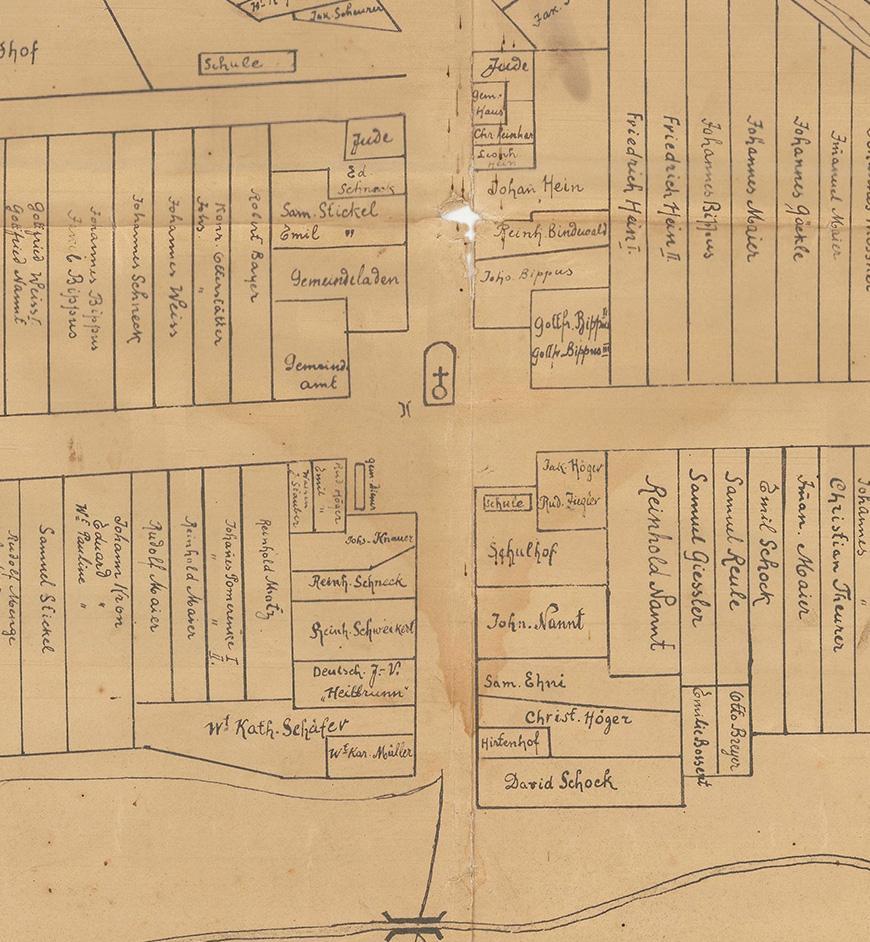
The present map is likely the most detailed surviving record of Borodino from its twilight days. In ultra-large scale, it depicts every colonist’s plot, naming the landowners of each, as they form strips emanating from the main thoroughfares. In the main square and the public buildings, such churches and schools, the centres of social life in what was a closely-knit community, with the ‘Freidfhof’ (cemetery), being in the upper centre, while to the south are shepherd’s fields.
Kashuba and Sapozhnikov’s article highlights the significance of a certain detail on the map, in the lower left, being the mound labelled ‘Sandhügel Alter Tatarenfriedhof’ (Sand Hill / Tatar Cemetery), the site of a major archaeological find made in 1912, that is the subject of said article.
In the upper left corner, below the title, is a box of text entitled ‘Nähere Angaben’ (More Details), that discusses Borodino’s history and its state on the eve of the ‘Umsiedlung’ (resettlement). Importantly, it notes that, as of October 1940, Borodino had population of 2,763, consisting of 610 families living in 463 homes.
The Bessarabian Germans: A Teutonic Agrarian Island in a Moldovian Sea
During the Russo-Turkish War of 1806 to 1812, Russia conquered the region of Bessarabia (approximating today’s Republic of Moldova and the western part of Ukraine’s Odessa Oblast). Czar Alexander I needed industrious, reliable Christians to anchor Russia’s hold over the land and turned to German immigrants as a solution. For decades Germans had already been invited to form ‘colonies’ in the Russian Empire and they had proven to be self-reliant and politically cooperative; it was assumed that the same would occur in Bessarabia. Meanwhile, the German states had been ravaged by the Napoleonic Wars, leaving many previously successful farmers in dire straits.
Starting in 1814, the Russians managed to convince 9,000 Germans to immigrate to Bessarabia, who formed 42 agrarian colonies, of which Borodino (established in 1814) was one of the first. The Germans settlers hailed variously from Baden, Württemberg, Prussia and Bavaria, and most were highly skilled famers with experience operating in a similar climate.
The Czar promised the Germans free land grants, interest free credit, exemption from taxes for the first decade, religious freedom, and an exemption from military service. As such, the colonies formed their own ‘self-contained’ Teutonic islands within a larger ethnic Slavic-Romanian realm. While the going was initially tough, the Germans eventually found ways to successfully farm their lands and were considered to be amongst the Czar’s most ‘trouble free’ subjects – Alexander’s ‘experiment’ was a success.
Over the coming decades the German colonies in Bessarabia continued to grow and prosper, with new colonies being established. World War I, which saw Germany’s defeat, was a stressful time for the Bessarabian Germans, as the region was taken over by Romania. While the new regime confiscated some land from the larger German estate owners, the colonies managed to survive with relatively limited interference from Bucharest.
By the late 1930s, there were over 150,000 Bessarabian Germans living in 150 separate colonies all over the region.
The Molotov-Ribbentrop Pact (August 23, 1939), the Soviet-German non-aggression accord that presaged World War II, divided Poland and Bessarabia into future zones for the conquest the respective parties, with the Soviets being allotted Bessarabia. The Pact featured secret clauses that called for the removal of the Bessarabian Germans, who the Soviets saw as a long-term threat to their rule over the region. Indeed, the German colonists tended to be religious and were naturally anti-Communist, so would not have wanted to remain even if that was an option.
The Soviets conquered Bessarabia from Romania during a quick campaign that lasted from June 28 to July 3, 1940. While the Bessarabian Germans saw the writing on the wall, they were informed that pursuant to the German-Soviet understanding, that their removal would be orderly. Hitler placed responsibility for relocating the colonists with the SS.
Beginning in September 1940, the Bessarabian German colonies were rolled up, with their residents being resettled in occupied Poland, on farms that had been confiscated from their former owners (Borodino was evacuated in October 1940). The process was well coordinated, with the colonists being given German citizenship and new farmsteads upon their arrival in Poland. However, this occurred in a wartime environment, whereby all of the men of fighting age were drafted into the Wehrmacht almost as soon as they arrived.
As the Nazis faced defeat with the Soviets conquering Poland in 1944-5, the transplanted Bessarabian Germans had to move, once again, this time behind German lines. In the wake of the conflict, almost all fled to what became West Germany, so as to avoid the Soviet-backed regime in East Germany.
The Bessarabian Germans integrated well into modern German society, with some attaining prominent roles. Notably, Horst Köhler (b. 1943), who served as the President of Germany from 2004 to 2011, was born in Poland to exiled Bessarabian Germans.
While the northern two-thirds of Bessarabia became the Moldavian SSR (and later the Republic of Moldova), the southern part, including Borodino, was annexed to Ukraine.
Today, Borodino, having long been settled by Soviet peoples, is a small Ukrainian town of around 1,800 residents. Few traces of the 136 year-long German presence remain.
References: Maya KASHUBA and Igor SAPOZHNIKOV, ‘История находки Бородинского (Бессарабского) клада’ [The History of Finding the Borodino (Bessarabian) Hoard], in Revista Arheologică, Serie nouă, vol. XVI, nr. 1 (Chişinău, 2020), pp. 21-47; esp. pp. 29, 32 (fig. 13) and 46.
![TURKEY – STATISTICAL MINING ATLAS: معدن احصائياتي اطلاسي [Maden Ihsaiyati Atlasi / Mining Atlas of Turkey].](https://pahor.at/wp-content/uploads/2020/06/65777s-265x331.jpg)
![SPAIN – BADAJOZ / NAPOLEONIC WARS MANUSCRIPT MAP: [Untitled Manuscript Plan of the Siege of Badajoz (1812)].](https://pahor.at/wp-content/uploads/2020/06/65676-265x331.jpg)


Reviews
There are no reviews yet.