


Description
BURMA – THE FOUNDATIONAL MODERN MAP / FIRST ANGLO-BURMESE WAR (1824-6) / CALCUTTA IMPRINT:
OFFICE OF THE SURVEYOR GENERAL OF INDIA. / [Francis BUCHANAN-HAMILTON (1762 – 1829)].
Calcutta: Asiatic Lithographic Press, 1825.
Lithograph, with original outline hand colour, on four sheets each dissected into 6 sections and mounted upon original linen with light blue silk edging and printed pastedown labels to verso, housed in an original blue card chemise and a marbled card slipcase bearing a printed pastedown label to the upper cover (Excellent condition, an almost perfect example, remarkably clean and bright with lovely wash colours; slipcase with generally light wear with surface loss to lefthand edge), each sheet approximately: 46 x 99.5 cm; if joined would form a map approximately: 184 x 99.5 cm (72.5 x 39 inches).
Burma was long a fabled and enigmatic land, incredibly rich in resources, being able grow more rice that all of India, home to great Teak forests and the world’s most prodigious ruby mines, not to mention its vast gold deposits. It was famed for its martial prowess and was constantly at war with its neighbours, a factor that traditionally caused European colonial powers to steer clear of the country.
Burma came under the rule of the Konbaung Dynasty in 1752, continuing a 900-year-long chain of monarchic rule established by the Pagan Dynasty (849 – 1297). During this era, Burma as often known to foreigners as the ‘Kingdom of Ava’, due to the name of its sometime capital Ava (it served as the capital from 1821 to 1842), located near Amarapura (Mandalay). After conducting numerous operations over the years against the Siam and China, the Burmese invaded Assam and Manipur in 1817, so bringing them too close for comfort to British India.
Britain, upon vanquishing the Maratha Empire, in 1818, had consolidated it dominance over Peninsular India. Expansionist diehards in the hierarchy of the East India Company (EIC) wanted Britain to continue making conquests and saw Burma, with its untold riches, as the ultimate prize, while Burma’s ‘forward policy’ in invading the territories to the immediate east of Bengal, caused many to believe that Britain must take pre-emptive defensive action. Yet, both Lord Amherst, the Governor-General of India and King Bagyidaw of Burma were initially hesitant to go to war against each other, fearing that their respective armies might overextend themselves.
A series of border skirmishes between British proxies and Burma broke out into direct conflict, resulting in the First Anglo-Burmese War (March 1824 – February 1826). The Burmese, under General Maha Bandula, were amongst the world’s best frontier warriors, and they used their superior knowledge of the rugged, jungle-covered terrain to gain the upper hand during the early part of the conflict. However, in what was a ‘shock and awe’ move, the British landed 10,000 troops, having sailed in 62 ships, in Rangoon, seizing Burma’s main port. This utterly rattled the Burmese, knocking them off their game. A frontal attack upon the British positions in Rangoon failed, and the Burmese never regained their momentum. The British won a decisive victory at the Battle of Prome (November-December 1825), compelling the Burmese to agree to peace on Britain’s terns.
At the Treaty of Treaty of Yandabo (February 25, 1826), Burma agreed to cede its provinces of Arakan, Karen and Tenasserim to Britain, and renounce their claims to the northeastern Indian states of Assam and Mirpur, etc., which were duly annexed by Britain. Additionally, they were to pay Britain an indemnity of £1 million (then an astounding sum), and to agree to onerous commercial trading terms.
For Britain, the war was arguably a pyrrhic victory, as it lost 15,000 troops and had spent between £5-13 million (£400 million – £1.07 billion in 2023 terms). The staggering debts from the conflict hobbled the EIC for years, contributing to the Company’s downfall in 1858.
Britian would subsequently assume a forward position in Burma, conquering Lower Burma during the Second Anglo-Burmese War (1852-3) and then the rest of country during the Third Anglo-Burmese War (1885), upon which the Konbaung Dynasty was dissolved.
The Present Map in Focus
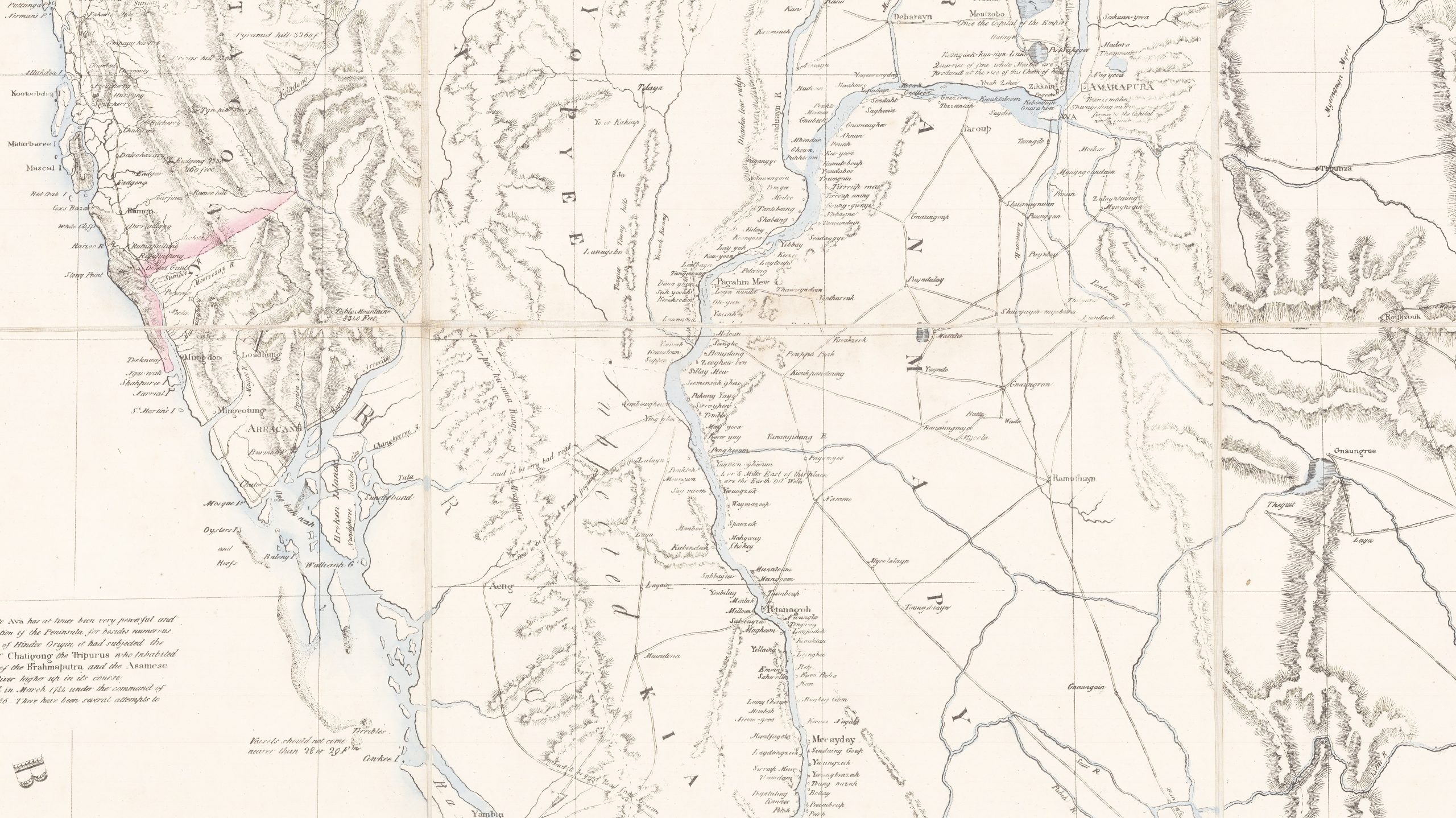
The present map is the foundational modern map of Burma, being the first realistic (albeit not planometrically accurate) printed general map of the country, as well as one of the most significant early lithographic productions made in India. It was published in Calcutta by the Asiatic Lithographic Press during the height of the First Anglo-Burmese War and would have served as an invaluable strategic aid for the British forces during that endeavour.
The map is billed as having been “Compiled at the Office of the Surveyor General of India”. In the ‘Construction’ section, on the lefthand, there is listed a series of geodetic basepoints, cited as having been derived from maps and sea charts such as those by Thomas Rennell, John Ritchie and Alexander Dalylmple. Text passages reveal that the depiction of Yunnan comes from the eminent 18th century Jesuit cartographer Jean-Baptiste Du Halde, while the course of the Irrawaddy is partially derived from Thomas Wood’s, Draught of the River Irrawaddy or Irabatty, From Rangoon to Ummerapoora, the present Capital of the Birman Dominions, Made between the Months of May and December 1795 (published 1800). It is also noted that “The detail of The Sea Coast has been adapted from the Sea Charts already referred to” but that editing was “necessary to reconcile their differences”.
Most significantly, it is noted that “The Surveys of the Erewadi as far up as Amarapurna”, in addition to Wood’s map, were derived from “Native Itineraries & Verbal Accounts” of which “The principal number of these were supplied by Dr. Buchanan’s Journal without the assistance of which the present undertaking would have been nugatory”. This refers to maps and geographical descriptions left in the official archives in Calcutta by Francis Buchanan-Hamilton (1762 – 1829), a renowned Scottish physician, botanist and surveyor who accompanied Captain Michael Symes (and the cartographer Thomas Wood) on an embassy to the Konbaung court in 1795 (resulting in the famous book, Symes’s An Account of an Embassy to the Kingdom of Ava sent by the Governor-General of India in 1795 (London, 1800)).
Indeed, an antecedent of the present map, drafted to the same scale of 16 miles to 1 inch (1:1,013,760), but of smaller scope (showing only the northern three-quarters of Burma), A Geographical Sketch of the Burmese Empire, Compiled in the Surveyor General’s office Calcutta, July 1824, is labelled as having been “Compiled by H. Hamilton at the office of the Surveyor General of India, with contributions from Dr. Francis Buchanan-Hamilton’s 1795 survey”. This refers the fact that the map was put together by an ‘H. Hamilton’, who is recorded as having been a draughtsman at the Surveyor General’s Office, from Buchanan-Hamilton’s source material, which was almost certainty more important in the creation of the present map than the ‘Construction’ section reveals.
While Symes’s mission was diplomatically unsuccessful (the Burmese hoodwinked him with a bunch of meaningless promises), it was hugely beneficial in expanding British (and indeed Western) knowledge of the country that Buchanan-Hamilton called the “Great Middle Continent”.
During the 1795 mission, Buchanan-Hamilton personally mapped Arakan and Ava and was given access a vast corpus of Burmese maps at the royal court, some of which were highly sophisticated. He made many manuscript maps and wrote 13 papers on geographic subjects.
In 1798, Buchanan-Hamilton mapped part of the Bengal-Burmese border, writing an “Account of the Frontier Between Ava and the Part of Bengal Adjacent to the Karnaphuli River” (1825) (for more on the significance of Buchanan-Hamilton’s mapping of Burma, see Joseph E. Schwartzberg’s fascinating article cited below).
The present map embraces all of Burma in within its current boundaries, with the ‘Explanation’, on the lefthand side explaining the colour-coding employed for the British Frontier (Red), Burmese Frontier (Green) and the Chinese Frontier (Yellow). The map delineates the coastlines and charts the courses of innumerable rivers, while mountain ranges are expressed by hachures. A great many cities, towns and villages are labelled, with a great density shown along the major travel corridors, being key rivers, roads and passes.
While far from being scientifically accurate, the work is the first map of Burma to be realistic, and its depiction of the coasts and the Irrawaddy from Mandalay down to its great delta is quire decent. It provides a stellar foundation for the future mapping of the country.
Notably, key details of the present map would be borrowed by the important work, A Map of the Burman Dominions, and Adjacent Countries, which appeared within John Crawfurd’s Journal of an Embassy from the Governor General of India to the Court of Ava in the year 1827 (London 1829).
The present map features many intriguing details and annotations relating to politics and Burma’s vast resources. To the immediate north of Rangoon is labelled the ‘Shuyagoan Pg.’ (Shwedagon), being the famed gold-plated temple, while further north is Sarawad “A great Mart for Teak wood’. Beyond, to its northeast, is Shue Gaen where “The Earth in certain places here yields Gold dust of rich quality’, while further still is an “Extensive Hilly Tract Occupied by the Karaen who in 1795 rejected the Authority of the King of Ava”. Near Bassein, in the southwest is Laming “from which place more than 100 boats go to Calcutta Annually’. Part way up the Irrawaddy, it is noted that ‘4 or 5 Miles East of this place are the Earth Oil Wells’.
In the upper centre of the map is ‘Amarapura’ (Mandalay) and the nearby alternative capital of Ava. In northern Burma is the “Route of the Burmese army to Assam from Amarapura’, during their 1817 invasion of that state. In the hills on the opposite bank from Ava are ‘Quarries of fine Marble’. In the northeast is Momeit, where it is said that ‘near this are the principal Ruby Mines in the Kingdom’, while Bhamo is ‘a great Mart of the Chinese trade’.
At Bouayn it is noted that it “was conquered from the Chinese by the Burmese in the reign of Zahnrusham who governed Ava from 1769 to 1781. The Inhabitants are Shan the place being originally a portion of Lowa Shan, or Southern Loas”. At Trung, it is remarked that “Once an Independent Kingdom is said that the earth in certain places here yields Gold dust of a rich quality. In 1795 it was held as an appendage of the King’s second son’. In the far north, it is noted that at ‘The Bong Domains were Invaded in 1768 by the Burmese Army and rendered Tributary’.
On the lefthand side, the map is rounded out with a ‘Glossary’ of Burmese topographical terms and an explanation of Burmese measurements of distance. There is them a ‘Table of Road distances between some of the principal places in the Burmese Empire’.
The present map was always rare and expensive. An advertisement for ‘Lithographic Publications… Published at the Asiatic Lithographic Company’s Press’, in The Quarterly Oriental Magazine, Review and Register, vol. 5 (Calcutta, January – June 1826), reads:
“A Geographical Sketch of the Burmese Empire, compiled at the Office of the Surveyor General of India, and published with Permission of Government. Measuring 6 ft.2 in.by 3 ft. 3 in. Coloured – Mounted on cloth or rollers, or in case, Sa. rs. 48-0-0 [48 Rupees – then a large sum!]. This is the best map of the Burmese Empire that has as yet been published — and the publishers have only 5 or 6 copies left on hand. It contains a Table of the estimated distances between some of the principal places in the Burmese Empire, Scale 16 miles to one inch.”
The advertisement goes on to make reference to the availability of a “reduced” edition, done to scale of “48 British Miles to the inch”, that “differs only from the other as to size, it is therefore more crowded with names, which has only this disadvantage”, and which was priced 10 Rupees.
A Note on Rarity
The present map is extremely rare, consistent with all early large-format Calcutta imprints. It would have been issued in a very limited print run and would have had a low survival rate. We can definitively trace examples in 3 libraries, being the British Library, University of Cambridge Library and the Harvard University Library, while there is an unconfirmed holding by the Library of Congress. Moreover, we are aware of only a single other example as having appeared on the market in the last 25 years. The 1824 smaller antecedent map is likewise rare.
References: British Library: Maps 58765.(7.); University of Cambridge Library: Maps.a.342.82.1; Harvard University Library: MAP-LC ; (G7720 1825 .S8 ); OCLC: 693521953 and 1555392033; Asiatic Journal and Monthly Register for British and Foreign India, China and Australasia, vol. XXIII (London, January to June, 1827), p. 517; The Quarterly Oriental Magazine, Review and Register, vol. 5 (Calcutta, January – June, 1826), [Advertisements], ‘Lithographic Publications… Published at the Asiatic Lithographic Company’s Press’, p. ii. Cf. Joseph E. Schwartzberg, ‘Southeast Asian Geographical Maps’, in J.B. Harley and David Woodward (eds.), The History of Cartography, vol. II, book 2: Cartography in the Traditional East and Southeast Asian Societies (Chicago: University of Chicago Press, 1994), pp. 741-827.

![LUBOK: Иванъ Яковлевичъ Курейша Въ Преображенской больници вь Москви [Ivan’’ Jakovlevič’’ Kurejša V’’ Preobraženskoj bol’nici v’ Moskvi / Ivan Yakovlevich Kureysha v Preobrazhenskaya Hospital in Moscow].](https://pahor.at/wp-content/uploads/2020/06/65643-265x331.jpg)

